

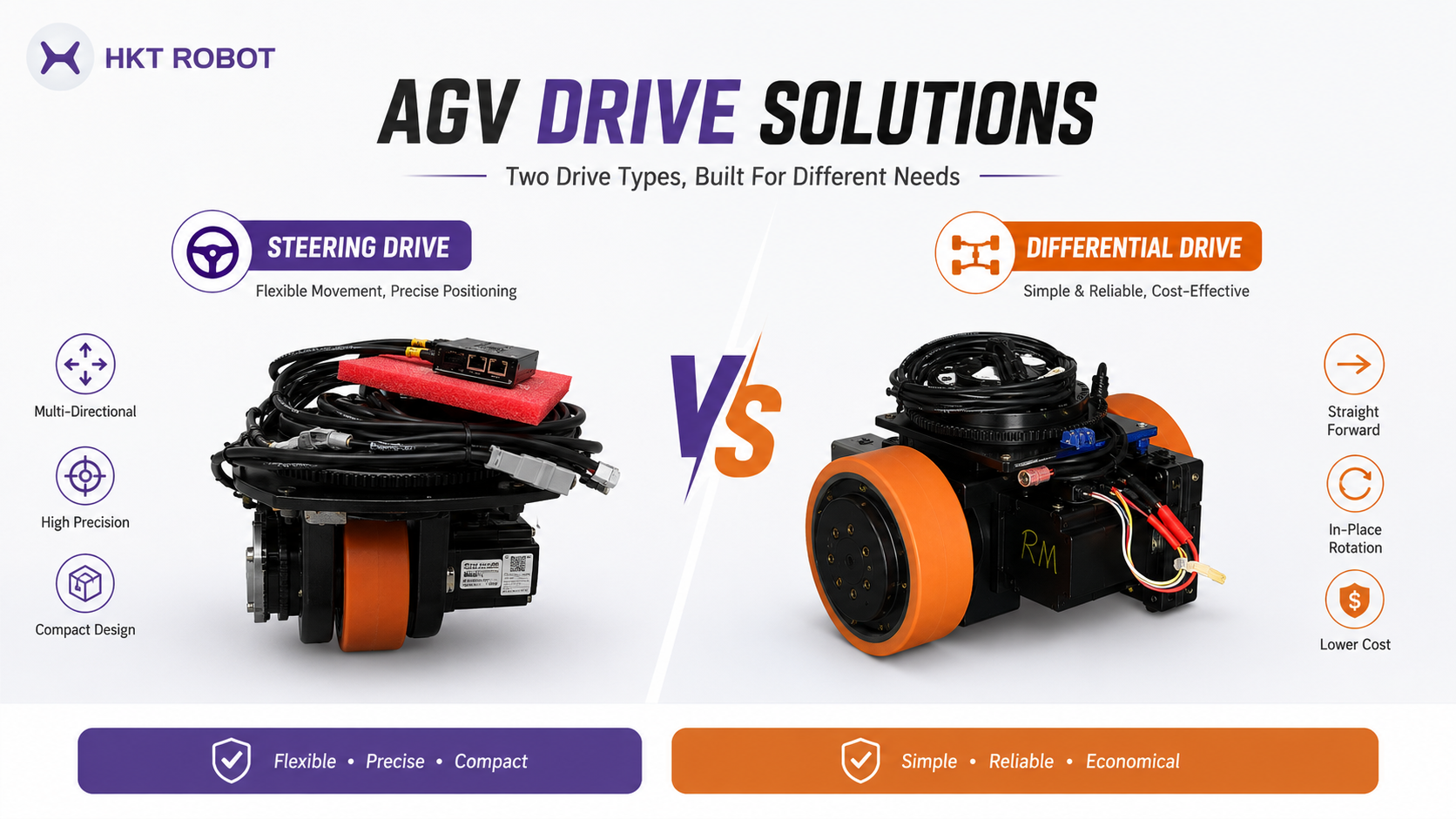
In AGV and AMR design, the drive method directly affects the vehicle’s mobility, chassis structure, control complexity, and project cost. AGV steering drive and differential drive are two widely used options. The choice is not simply between “better performance” and “lower cost.” Each system fits different movement requirements and working conditions.
This post compares their working principles, key performance differences, typical applications, and selection factors to help you choose the right AGV/AMR chassis drive system.
1. How The Two Drive Systems Work
1.1 AGV Steering Drive: Drive And Steering In One Module
An AGV steering drive wheel normally combines a drive motor, steering motor, gearbox, drive wheel, and steering encoder in one compact module. The controller adjusts both the wheel speed and steering angle according to the required direction and vehicle speed.
The available movement depends on the number and layout of the agv steering drive units. A single steering drive wheel with casters can handle normal forward movement and turning. Two steering drives provide greater traction and better path control. With coordinated control, three- or four-wheel systems can also support lateral movement, diagonal travel, and sideways movement while keeping the chassis orientation unchanged.
The main advantage of an AGV steering wheel module is that it can actively change the rolling direction of the wheel. This makes the vehicle easier to position in narrow spaces and around complex workstations.

1.2 Differential Drive: Steering Through Wheel Speed Difference
A differential drive chassis normally uses two powered wheels and one or more passive support wheels.
When both differential drive wheels run at the same speed, the vehicle moves straight. When their speeds are different, the vehicle turns. When the wheels rotate at the same speed in opposite directions, the chassis can rotate in place.
Because no separate steering mechanism is required, a differential drive system has a simpler mechanical structure and control method. Wheel encoders provide speed feedback, while IMU, LiDAR, vision, or other navigation sensors help correct the vehicle’s position and direction.
Differential drive is commonly used for warehouse transport, delivery robots, and standard mobile platforms that mainly need straight travel, turning, and in-place rotation.

2. Key Performance Comparison Between Steering Drive & Differential Drive
| Comparison | AGV Steering Drive | AGV Differential Drive |
| Steering Method | Controls both wheel speed and steering angle | Turns by changing the speed of the left and right wheels |
| Lateral Movement | Available with suitable multi-wheel layouts | Not available with a standard differential chassis |
| Path Flexibility | Better suited to complex paths and multi-direction docking | Well suited to regular and fixed routes |
| Installation Space | Requires space for both drive and steering mechanisms | Usually easier to use in a low-profile chassis |
| Control System | More complex, especially with several steering modules | Simpler and easier to develop |
| System Cost | Usually higher because of extra motors, encoders, and controllers | Usually lower with fewer components |
| Maintenance | The full module can be replaced, followed by steering calibration | Drive wheels, geared motors, and casters are often serviced separately |
| Typical Use | Narrow spaces, lateral docking, heavy loads, and flexible production | Warehousing, delivery, fixed routes, and high-volume projects |
3. Steering Drive Vs Differential Drive: Main Technical Differences
3.1 Motion Control And Positioning
A steering drive controls wheel speed and steering angle at the same time. This provides more flexibility when following curves, making lateral corrections, or docking from different directions.
Its positioning performance can still be affected by steering zero-point error, gearbox backlash, tyre deformation, installation accuracy, and synchronization between multiple steering units.
A differential drive changes direction through the speed difference between the left and right wheels. Its movement is more sensitive to wheel diameter differences, wheelbase settings, tyre wear, and floor friction. Uneven tyre wear or wheel slip during turning can cause odometry errors.
For both systems, final positioning accuracy also depends on chassis rigidity, parameter calibration, and the navigation system.
3.2 Structure And Maintenance
A steering drive combines the drive and steering mechanisms in one compact unit. This reduces external linkages, but fault diagnosis, steering calibration, and spare-part costs are usually higher.
A modular AGV steering drive unit can be replaced as a complete assembly to reduce downtime. After replacement, the steering zero position and control parameters normally need to be checked.
Differential drive uses fewer components. The drive wheels, geared motors, and support casters can often be inspected or replaced separately, which makes on-site maintenance and spare-part management easier.
3.3 Wear And Service Life
Wear in a steering drive is mainly affected by load, steering frequency, and synchronization between the drive modules.
A differential chassis may create sideways tyre friction during tight turns or in-place rotation. This is usually more noticeable on four- or six-wheel skid-steer chassis.
The real service life of either system depends on output torque, start-stop frequency, floor conditions, daily operating time, and the safety margin used during selection.
4. Application And Selection Guide
The right drive system should be selected according to the movements the vehicle must perform, not only according to the industry.
A steering drive is usually the better option when the AGV or AMR needs lateral movement, diagonal adjustment, multi-direction docking, or flexible positioning in a narrow space.
Differential drive is often more economical when the vehicle follows fixed routes and only needs straight movement, normal turning, and in-place rotation. It is also suitable for projects that are sensitive to chassis height, development time, and system cost.
4.1 Automotive And Heavy-Duty Transport
For engines, axles, moulds, and large tooling, double- or four-steering-wheel systems are useful when the vehicle must enter a workstation from the side or change direction frequently.
A heavy-duty differential drive can also work well when the route is fixed and enough turning space is available.
4.2 Warehousing And Logistics
Differential drive is widely used for shelf handling and warehouse transport because the routes are usually regular and large fleets need simple maintenance.
When the vehicle must dock sideways, enter a rack from the side, or reduce repeated reversing, an AGV steering drive system offers better flexibility.
4.3 Flexible Manufacturing Lines
In electronics, semiconductor, and medical equipment production, machines are often placed close together and docking directions may vary. A multi-steering-wheel chassis can make positioning and route changes easier.
For fixed workstations and regular routes, differential drive can still provide a practical solution.
Overall, the main selection factors are lateral movement, vehicle load, aisle width, chassis height, route layout, and maintenance conditions.
5. HKT ROBOT: Your Reliable AGV Drive Supplier
Since 2013, HKT ROBOT has focused on the development, production, and supply of AGV and AMR drive systems and core components. Our main products include AGV steering drive wheels, differential drive wheels, servo motors, controllers, and reducers, available for different payloads, chassis heights, wheel diameters, and communication interfaces.
With in-house engineering, stable product quality, and fast technical support, HKT ROBOT provides drive solutions for mobile robot manufacturers and automation integrators worldwide.
For AGV chassis selection, please send us the total vehicle weight, maximum payload, target speed, wheel diameter, turning method, installation space, and control interface requirements. Our team will help you select a suitable drive solution.
Share:
Custom AGV Differential Wheel: Specifications, MOQ, and Lead Time Explained
Low-Profile AGV/AMR Drive Units for Underride and Rack-Lifting Robots