

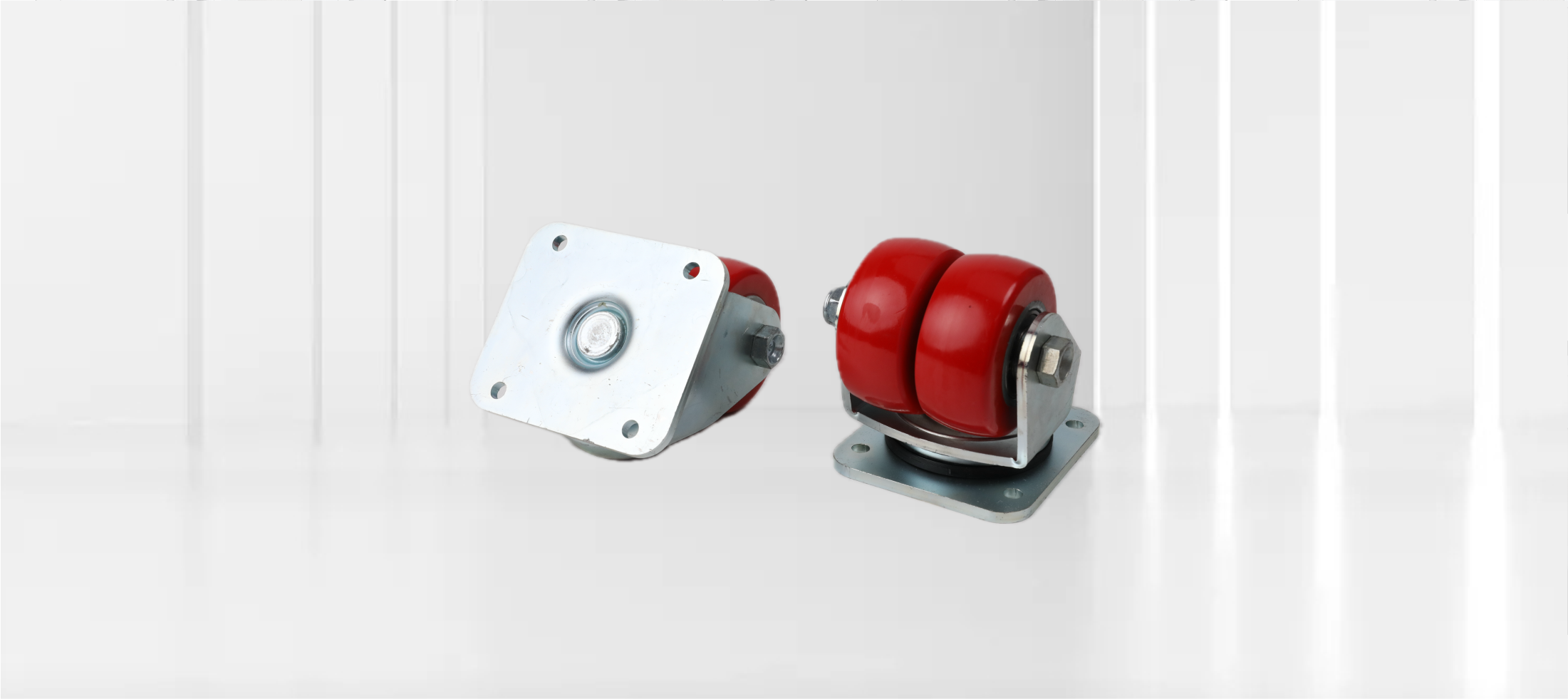
In professional AGV and AMR design, an AGV caster wheel is not merely a passive support component.
From an engineering perspective, it directly participates in the mechanical and kinematic behavior of the chassis.
Proper caster design affects:
-
Load distribution
-
Normal force on drive wheels
-
Steering resistance torque
-
Motion control accuracy
Load Distribution and Mechanical Balance
In a typical 2-drive + 2-caster configuration, insufficient caster stiffness or poor mounting accuracy will cause load concentration on the drive wheels.
This results in:
-
Increased rolling resistance
-
Higher continuous motor torque
-
Reduced gearbox and bearing lifetime
Best practice:
Drive wheels should carry 45%–55% of total vehicle weight.
Kinematic Influence During Steering
Swivel caster wheels introduce scrub torque during rotation, especially in zero-radius turns.
Poorly selected casters may cause:
-
Abnormally high turning current
-
Low-speed vibration
-
SLAM positioning deviation in AMRs
Key influencing factors:
-
Wheel diameter
-
Offset distance
-
Tread friction coefficient

Engineering-Level Selection Parameters
| Parameter | Engineering Impact | Recommendation |
|---|---|---|
| Rated load | Long-term deformation | ≥ 1.5× actual load |
| Wheel diameter | Obstacle crossing | ≥ 150 mm for heavy AGVs |
| Tread hardness | Rolling resistance | PU 85–95A |
| Offset distance | Self-alignment | Smaller for AMRs |
| Bearing type | Reliability | Dual ball or tapered |

Coordination with Servo Drive Wheels
Mismatch between caster wheels and servo drive wheels may lead to:
-
Control compensation overload
-
Encoder-based odometry error
-
Motion instability at low speed
Design rules:
-
Diameter difference within ±5%
-
Unified tread materials
-
Controlled swivel damping for precision AMRs
Share:
Steering Wheel Drive vs. Differential Drive: Making the Right Choice for Your AGV
Caster Wheel Integration Solution for Servo-Driven AGV