

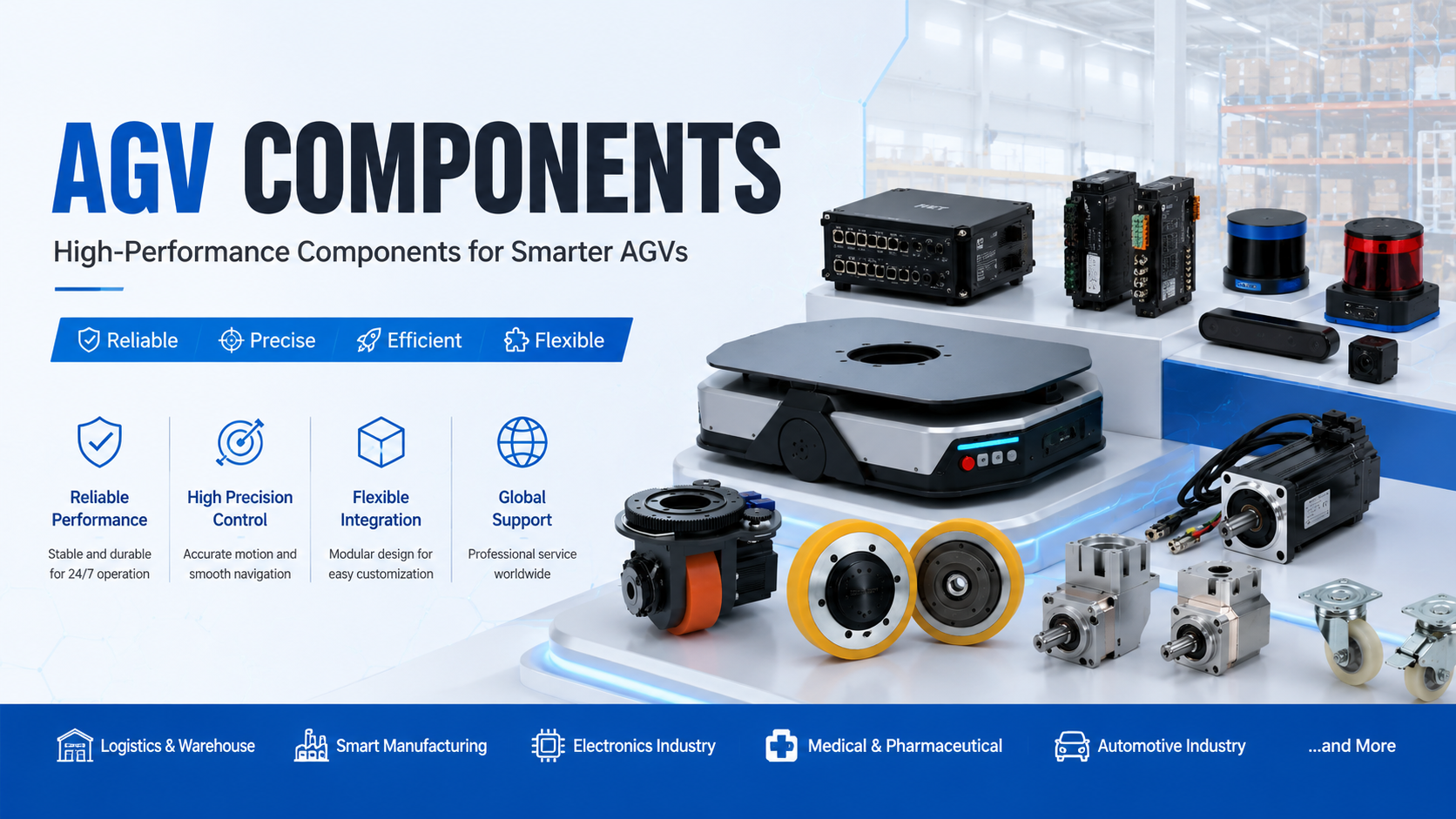
Automated Guided Vehicles (AGVs) are widely used in warehouses, factories, and logistics centers to automate material handling with consistent accuracy and control. Behind these capabilities is a set of well-coordinated AGV components that determine how the system performs in real-world environments.
Although AGVs may vary in design, most are built around several core systems, including control, navigation, motion, safety, and power. These components work together rather than independently to ensure stable, accurate, and continuous operation.
In this article, we will dive deep into the key AGV components, explain their functions, and show how they contribute to the overall performance of an automated guided vehicle.

Detailed Overview of Core AGV Components
AGV components include mechanical, electrical, control, and software systems to enable an automated guided vehicle to receive tasks and navigate routes. They also support load handling, obstacle avoidance, and communication with factory or warehouse systems.
At HKT ROBOT, we classify the core AGV components into seven key categories. Below is a detailed breakdown of each component and its function.

Control System: The Brain of the AGV
The control system is the central brain of an AGV and one of the most important agv components.
It receives tasks, processes sensor data, controls vehicle movement, manages safety responses, and communicates with external systems.
Typical control system components include:
-
Main controller
-
PLC
-
Motion controller
-
Motor driver
-
I/O module
-
Sensor interface module
The controller receives information from the navigation system, safety sensors, battery system, and communication module. Based on this data, it sends commands to the motion system to control speed, steering, braking, and load handling actions.
For example, when an AGV receives a task to move goods from one workstation to another, the control system calculates or receives the route, checks vehicle status, controls acceleration and deceleration, and ensures the vehicle stops accurately at the target position.
A stable control system is essential for smooth movement, accurate positioning, multi-vehicle coordination, and safe operation.
Navigation System: an AGV Component that Knows Where to Go
The navigation system helps the AGV understand its position and follow the correct route. It provides the location information needed by the control system. Common AGV navigation components include:
-
Magnetic tape sensor
-
Magnetic nail sensor
-
QR code reader
-
Laser reflector sensor
-
LiDAR
-
Vision camera
-
IMU module
-
Positioning marker
Traditional AGVs often use magnetic tape, magnetic nails, QR codes, or laser reflectors. These methods are suitable for fixed routes and stable working environments.
More advanced AGVs and AMRs may use LiDAR SLAM or vision-based navigation. These systems allow the vehicle to recognize its surroundings, build maps, and adjust routes more flexibly.
The choice of navigation system affects positioning accuracy, installation cost, route flexibility, and maintenance requirements.
Motion System: A Key AGV Component for Movement
The motion system is responsible for movement, steering, braking, and maintaining vehicle stability. It receives commands from the control system and converts them into precise physical motion, allowing the AGV to transport materials safely and accurately.
Unlike other AGV systems, the motion system defines the vehicle’s mechanical performance. A well-designed system improves operating efficiency while enhancing load capacity, climbing ability, positioning accuracy, braking performance, and overall reliability, making it one of the most critical AGV components.
 HKT ROBOT, founded in 2013, specializes in AGV and AMR motion systems and offers a complete range of motion components, including steering drive wheels, differential wheels, servo motors, planetary gearboxes, integrated servo drives, caster wheels, and lifting mechanisms.
| Component | What It Is | Main Function | Typical Use |
| Drive Wheel | A powered wheel that transfers motor output to the floor. | Provides traction and moves the AGV forward or backward. | Most AGVs and AMRs |
| Steering Drive Wheel | An integrated module that combines driving and steering. | Enables turning, rotation, docking, and flexible movement. | Forklift AGVs, tugger AGVs, omnidirectional AGVs |
| Differential Wheel | A two-wheel drive structure where each wheel is controlled independently. | Controls direction by adjusting the speed difference between left and right wheels. | AMRs, cleaning robots, compact AGVs |
| Servo Motor | A motor with precise speed, torque, and position control. | Provides stable power for acceleration, deceleration, and accurate stopping. | High-precision AGVs and AMRs |
| Planetary Gearbox | A compact transmission unit connected to the motor. | Reduces speed and increases torque for heavier loads. | Medium and heavy-duty AGVs |
| Motor Driver | An electronic control unit for the motor. | Controls speed, torque, direction, braking, and communication with the controller. | Servo-driven AGVs |
| Encoder | A feedback device installed on the motor or wheel. | Sends speed and position feedback for closed-loop control. | AGVs requiring accurate positioning |
| Brake | A mechanical or electromagnetic stopping device. | Holds the vehicle safely when stopped, powered off, or on slight slopes. | Forklift AGVs, heavy-duty AGVs |
| Caster Wheel | A non-powered support wheel. | Supports vehicle weight and improves balance and turning stability. | Differential-drive AGVs, AMRs, latent AGVs |
Safety System: AGV Component to Avoid Accidents
The safety system protects workers, equipment, materials, and the AGV itself. Since AGVs often operate in shared spaces with people, forklifts, machines, and shelves, safety design is essential.
Common AGV safety components include:
-
Safety laser scanner
-
Emergency stop button
-
Safety bumper
-
Obstacle detection sensor
-
Warning light
-
Audible alarm
-
Safety controller
-
Speed limit function
The safety system can detect obstacles, slow down the vehicle, trigger an emergency stop, or warn nearby workers. For heavy-duty AGVs, the safety system must work closely with the braking system and motion control system to ensure safe stopping distance.
Power System: How the AGV Gets Energy
The power system supplies energy to all AGV components, including motors, controllers, sensors, communication modules, and load handling devices. Main power system components include:
-
Lithium battery
-
Battery Management System
-
Charging connector
-
Automatic charging station
-
Wireless charging module
-
Power distribution unit
Battery capacity affects operating time, charging frequency, and fleet efficiency. For high-load or long-shift AGVs, battery selection must be considered together with motor power, duty cycle, travel distance, and charging strategy.
Communication System: How the AGV Connects with Other Systems
The communication system allows the AGV to exchange data with fleet management software, warehouse systems, production systems, charging stations, and other vehicles. Common communication methods include:
-
Wi-Fi
-
Ethernet
-
CAN bus
-
EtherCAT
-
Modbus
-
5G
Through communication systems, AGVs can receive tasks, report status, update location, send alarms, and coordinate with other vehicles in the same working area.
In automated factories and warehouses, communication is important for connecting AGVs with WMS, MES, ERP, or fleet management systems.
Load Handling System: How the AGV Carries or Transfers Goods
The load handling system determines how the AGV carries, lifts, pulls, or transfers materials. Common load handling components include:
-
Fork mechanism
-
Lifting module
-
Roller conveyor
-
Belt conveyor
-
Tow hook
-
Jacking module
-
Customized fixture
Different AGV types require different handling structures. A forklift AGV needs a fork and lifting mechanism, while a conveyor AGV needs a roller deck or belt conveyor for automatic material transfer. A tugger AGV needs a towing structure, while a latent AGV may use a lifting module to move carts or racks.
Vehicle Frame and Auxiliary Components
In addition to the main systems, an AGV also requires structural and auxiliary components to support assembly, protection, and maintenance. These may include:
-
Vehicle frame
-
Mounting brackets
-
Covers and panels
-
Cable harnesses
-
Connectors
-
Shock absorbers
-
Fasteners
-
Protective housing
Although these parts may seem less important than controllers, motors, or sensors, they affect assembly efficiency, durability, maintenance convenience, and overall vehicle reliability.
Choosing the Right AGV Components for Your Application
Selecting AGV components is not only about choosing individual parts. Each component should match the overall vehicle design, working environment, payload, navigation method, and automation goal. A component that works well in a light-duty warehouse AMR may not be suitable for a heavy-duty forklift AGV or an outdoor transport vehicle.
Simply put, engineers should evaluate the AGV as a complete system before selecting motors, wheels, controllers, sensors, batteries, and load handling modules. Important factors include:
-
Total vehicle weight
-
Payload capacity
-
Travel speed
-
Turning radius
-
Floor condition
-
Working environment
-
Navigation method
-
Required positioning accuracy
-
Battery runtime
-
Communication protocol
-
Installation space
-
Maintenance requirements
Conclusion
AGV components are the foundation of every automated guided vehicle. From the control system and navigation sensors to the motion system, safety devices, power supply, and load handling structure, each part plays a role in how reliably and efficiently the vehicle performs.
As factories and warehouses continue to adopt automation, choosing the right AGV components will become even more important for improving productivity, reducing manual handling, and building safer material flow systems.
As one of the leading AGV and AMR manufacturers in China, HKT ROBOT can provide agv components you need and customized solutions tailored to your need.
Looking for agv components for your next project? Contact HKT ROBOT to discuss your vehicle requirements and find a suitable solution.
Share:
Brushless Servo Motor for AGV: Key Specs and Selection Guide
Robot Drive Wheels for AGV & AMR