

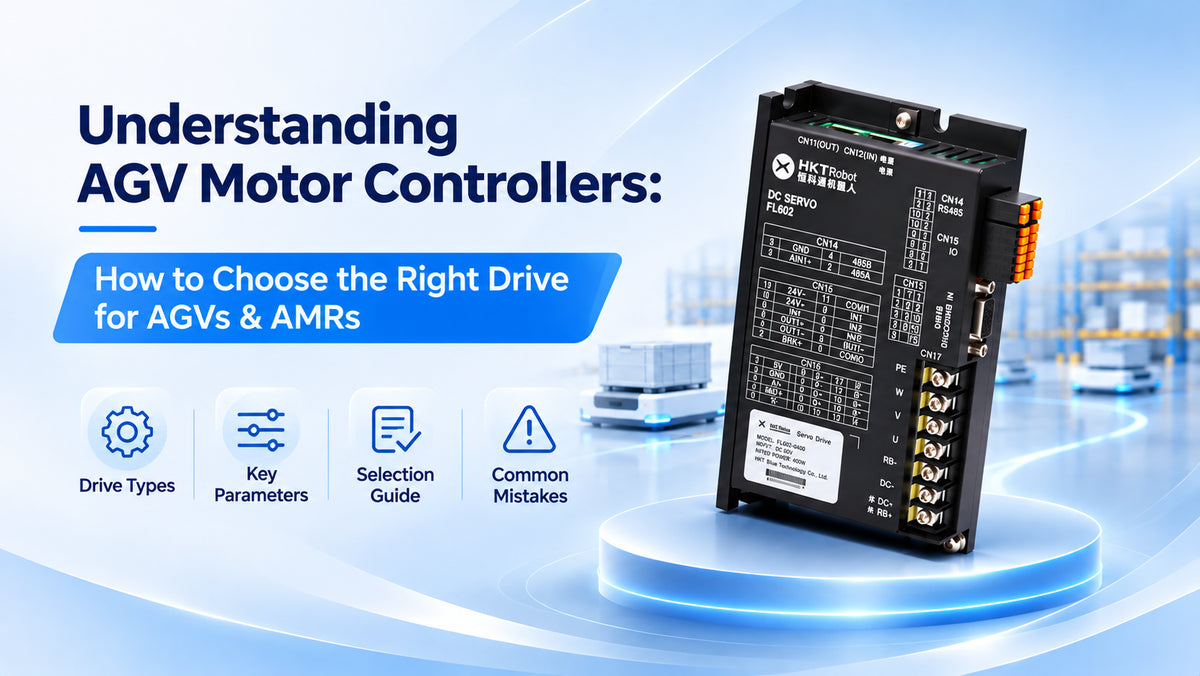
Does your AGV start smoothly when empty but struggle to accelerate once fully loaded? Does it run normally during bench testing, only to develop communication errors after being connected to the main control system?
These problems often come down to an important agv component: the agv motor controller—also known as the agv drive that translates control commands into motor speed, torque, and feedback response.
However, choosing the right AGV motor controller is more than matching the motor power. Battery voltage, current capacity, encoder compatibility, communication protocols, and drive configuration all affect the system's performance.
This guide explains how AGV motor controllers work, which specifications matter most, and how to choose a suitable drive for different AGV and AMR applications with HKT ROBOT's hands-on experience over the years.

What Is an AGV Motor Controller?
An AGV motor controller, also known as an AGV drive, is one of the key components of an AGV. It controls motor speed, torque, and direction based on commands from the vehicle's control system.
It acts as the link between the AGV's main controller and the motor. While the main controller determines the vehicle's required movement, the AGV motor controller receives motion commands and regulates the electrical power supplied to the motor to execute those commands.
The basic control relationship is:
AGV Main Controller → AGV Motor Controller (Drive) → Motor → Gearbox → Drive Wheel
In short, the AGV motor controller translates motion commands into controlled motor output, enabling the AGV to accelerate, decelerate, and move as required.
How Does an AGV Motor Controller Work?
To understand what an AGV motor controller does, consider a warehouse AGV transporting materials between workstations.
When the vehicle receives a transport command, its main controller calculates the required movement and sends a speed or torque command to the motor drive. The drive regulates the motor current to produce the required motion.
As the AGV accelerates, the controller must deliver sufficient torque while respecting the motor's and drive's electrical limits. Once the vehicle reaches its target speed, the drive continues adjusting its output to compensate for changes in load and operating conditions.
When the AGV approaches its destination, the main controller requests deceleration. The motor drive follows the commanded motion profile and, in a closed-loop system, uses feedback to correct deviations.
Three functions are particularly important during this process.

Speed and Torque Control
Speed control determines how quickly the motor rotates, while torque control regulates the motor's turning force.
For example, an AGV carrying a heavy load may need substantially more torque during acceleration or uphill travel than when moving on level ground without a payload.
A properly matched motor controller must deliver the required current without exceeding its continuous or short-term operating limits.
Smooth speed regulation also matters at low speeds, particularly when an AGV approaches a docking station or moves through a narrow operating area.
Position and Feedback Control
Many AGV servo drives support closed-loop control using motor encoders.
An encoder provides information about motor rotation, allowing the drive to monitor actual speed or position and compare it with the commanded value.
This helps the drive respond to disturbances and maintain more consistent motor behavior.
However, motor position accuracy and vehicle positioning accuracy are not the same thing. Wheel slip, gearbox backlash, mechanical deformation, navigation errors, and chassis geometry can all affect the final stopping position of an AGV.
The motor controller contributes to motion precision, but it does not replace the vehicle's navigation and positioning system.
Deceleration, Braking, and Fault Monitoring
During deceleration, the motor drive controls the reduction in motor speed. Depending on the motor and drive design, some of the vehicle's kinetic energy may be returned to the DC bus through regenerative braking.
This creates an additional electrical consideration: the system must be able to handle the regenerated energy without exceeding the drive's permitted bus voltage.
Motor drives may also monitor overcurrent, overvoltage, undervoltage, overheating, and other abnormal conditions.
These protective functions help reduce the risk of electrical damage, but they should not be confused with a complete AGV safety system. Emergency stopping, mechanical holding brakes, and safety-rated functions require appropriate system-level design and verification.
Types of AGV Motor Controllers
AGV motor controllers can be classified in several ways, including motor technology, control method, number of controlled axes, and physical integration.
According to compatible motor type, common options include brushed DC motor controllers, BLDC motor controllers, and servo drives. Each has different characteristics and is suited to different AGV and AMR applications.
| Motor Controller Type | Main Characteristics | Typical Applications |
| Brushed DC Motor Controller | Controls brushed DC motor speed and torque, typically using PWM to regulate motor voltage and current | Simple AGVs and cost-sensitive mobile platforms |
| BLDC Motor Controller | Uses electronic commutation to control brushless DC motors, with Hall sensor, encoder, or sensorless operation depending on the design | Compact AGVs, AMRs, and hub-motor drive systems |
| Servo Drive | Uses closed-loop feedback to provide precise current, speed, and/or position control, depending on the drive and motor configuration | Precision AGVs, AMRs, steering systems, and heavy-duty mobile robots |
These are common product categories rather than strictly separate control technologies. For example, some BLDC motor controllers also support closed-loop servo control.
A servo drive is not automatically the best choice for every AGV.
The right AGV motor controller depends on the motor type, required control precision, load conditions, and overall system design. Beyond the controller type, factors such as voltage, current capacity, encoder compatibility, and communication interfaces are equally important when selecting a suitable AGV drive.
Key Specifications to Consider When Choosing an AGV Motor Controller
The most important part of selecting an AGV motor controller is understanding how its electrical and control characteristics match the actual vehicle.
Two controllers may support the same nominal battery voltage and motor power but behave differently under acceleration, repeated start-stop operation, or sustained load.
Battery Voltage and Operating Range
Most battery-powered AGVs use low-voltage DC systems, with 24V and 48V being common configurations.
However, the nominal battery voltage is only a starting point.
A 48V battery system does not maintain exactly 48V throughout operation. Its voltage varies with battery chemistry, state of charge, charging conditions, load, and regeneration.
The motor controller must therefore support the actual minimum and maximum DC bus voltage expected in the vehicle.
For example, HKT ROBOT lists a 400W low-voltage AGV servo drive with a 24–60VDC input range. This illustrates why checking the full operating range is more useful than looking at a nominal 48V label alone.
When evaluating a drive, also consider undervoltage thresholds, overvoltage protection, and how the system handles regenerated energy during deceleration.
Continuous Current and Peak Current
Motor power is useful for initial product screening, but current ratings are essential for evaluating torque capability.
For many servo motors, torque is approximately proportional to torque-producing current within the motor's normal operating range.
The drive must therefore provide sufficient current for both continuous operation and short periods of high torque demand.
Consider an AGV that repeatedly accelerates, travels a short distance, stops, and starts again. Even if each acceleration period is brief, the repeated current peaks can generate substantial heat in the motor and drive.
A controller selected only for its advertised peak current may not have enough continuous capacity for this duty cycle.
The correct selection should consider motor current requirements, acceleration frequency, ambient temperature, cooling conditions, and the drive's overload characteristics.
Motor Type and Encoder Compatibility
An AGV motor controller must be electrically and functionally compatible with the motor it controls.
This includes the motor technology, rated voltage, current requirements, pole configuration where applicable, and feedback system.
For closed-loop servo applications, encoder compatibility is particularly important.
Incremental encoders provide relative movement information, while absolute encoders can provide position information within their specified range without relying on incremental pulse counting alone.
The drive and encoder must use matching electrical interfaces, signal formats, communication protocols, and resolution settings.
Before selecting a drive, verify the exact motor and encoder model rather than assuming that any servo drive will work with any servo motor.
Communication Interface and Control Modes
The AGV motor controller must exchange commands and operating information with the vehicle control system.
Common communication technologies in mobile robot applications include CAN-based networks, CANopen, EtherCAT, and Modbus RTU over RS485.
These terms describe different layers of communication. For example, CANopen is a communication protocol built on CAN, while RS485 defines an electrical interface commonly used by protocols such as Modbus RTU.
Matching the physical connector is not sufficient. Both devices must support compatible communication settings, command structures, operating modes, and feedback data.
Control modes are equally important.
Some applications primarily require speed control, while others need torque or position control. A steering axis, for example, may require position control to maintain the commanded wheel angle.
For a closed-loop servo system, the selected drive must support the operating modes required by the AGV's motion-control architecture.
Installation, Thermal Management, and Protection
AGV chassis designs often have limited space for electrical components.
A compact motor drive can simplify packaging, but installation dimensions are only one part of the decision.
The drive also needs sufficient ventilation or an appropriate heat-dissipation path. High ambient temperatures, enclosed electrical compartments, and repeated acceleration can increase thermal stress.
Engineers should check mounting orientation, cable routing, connector accessibility, environmental ratings, and cooling requirements.
Protection functions such as overcurrent, overtemperature, overvoltage, undervoltage, and motor overspeed monitoring can also help prevent damage during abnormal operation.
The exact protection functions and their behavior depend on the selected drive model.
Common AGV Motor Controller Selection Mistakes
Several integration problems can be avoided by reviewing the motor-drive combination before the chassis design is finalized.
One common mistake is choosing a drive based only on motor wattage. A 400W motor and a drive advertised for 400W applications are not necessarily compatible. Their voltage, continuous current, peak current, feedback, and operating requirements must also match.
Another is overlooking encoder compatibility. Even when a motor and drive support the same general encoder category, differences in signal format or protocol can prevent successful commissioning.
Communication compatibility is also frequently underestimated. Two products may both advertise CAN connectivity but use different communication protocols or command definitions.
Finally, the duty cycle matters. A drive that performs well during a short demonstration may experience thermal limitations during continuous operation with frequent acceleration, deceleration, and high payloads.
A practical selection process should therefore begin with the vehicle's actual operating conditions and then verify the motor, drive, feedback, and communication requirements together.

HKT ROBOT: Your Reliable Partner for AGV Motor Controllers and Motion Components
An AGV motor controller is more than a device that turns a motor on and off. It is responsible for translating motion commands into controlled motor output and plays an important role in how consistently an AGV accelerates, travels, decelerates, and responds to changing loads.
The right AGV drive should match the motor's electrical requirements, support the necessary feedback and communication interfaces, and provide sufficient current capacity for the vehicle's real operating conditions.
At HKT ROBOT, we don't regard agv motor controller as an independent part; We will choose it to enhance the overall AGV motion system.
We offer single-axis and multi-axis AGV motor controllers, featuring independently developed hardware and software, support for a wide range of communication interfaces and protocols, and compatibility with both absolute and incremental encoders. Designed to balance cost-effectiveness with reliable performance and quality, our controllers meet the diverse motion control requirements of AGV and AMR applications.
Beyond AGV motor controllers, HKT ROBOT, as a trusted AGV/AMR components manufacturer and drive solutions supplier with over 10 years of expertise, also provides servo motors, steering drive wheels, differential drive units, planetary gearboxes, and lifting mechanisms. We also support customized configurations based on motor specifications, communication requirements, installation constraints, and specific application needs, helping customers achieve better compatibility and smoother system integration.
Looking for the Right AGV Motor Controller for Your Project?
HKT ROBOT can help you evaluate a suitable AGV servo drive based on your motor, battery voltage, communication requirements, and application conditions.
Share your motor specifications or AGV project requirements with our team, and let us help you find a compatible drive configuration.
Frequently Asked Questions About AGV Motor Controllers
1. Can an AGV motor controller work with motors from different manufacturers?
Possibly, but compatibility must be verified. The motor type, voltage, current requirements, encoder interface, and supported control parameters must match the drive. Some servo drives require specific motor data or commissioning procedures before they can operate correctly.
2. Why does an AGV motor controller overheat during operation?
Overheating can result from excessive current demand, repeated acceleration, insufficient cooling, high ambient temperature, or incorrect motor and drive settings. Engineers should review the actual duty cycle and fault history rather than assuming that the controller is defective.
3. Can an AGV motor controller operate without an encoder?
Some motor controllers support sensorless operation, depending on the motor type and drive design. However, applications requiring precise low-speed control or closed-loop positioning often benefit from encoder feedback. Whether an encoder is required depends on the specific controller and application.
4. What happens if communication between the AGV motor controller and the main controller is lost?
The response depends on the drive's configuration and supported fault-handling functions. A drive may stop accepting commands, trigger a communication fault, or execute a configured deceleration response. The behavior must be verified during system commissioning, particularly where uncontrolled movement could create a hazard.
5. Can an AGV motor controller be used with a regenerative braking system?
Some motor drives support regenerative operation, but the complete electrical system must be designed to manage the returned energy. Depending on the battery, drive, and power architecture, additional energy-management measures may be required to prevent DC bus overvoltage.
6. What information should I provide when requesting an AGV motor controller?
It is helpful to provide the battery voltage range, motor model and rated power, continuous and peak current requirements, encoder type, communication protocol, number of controlled axes, and available installation space.
Vehicle information such as payload, speed, acceleration, operating slope, and duty cycle can also help determine whether the selected motor-drive combination is suitable.
Share:
AGV/ AMR Caster Wheel Selection Tips
How to Choose an AGV Motor: 24V vs. 48V Servo Motors Explained