

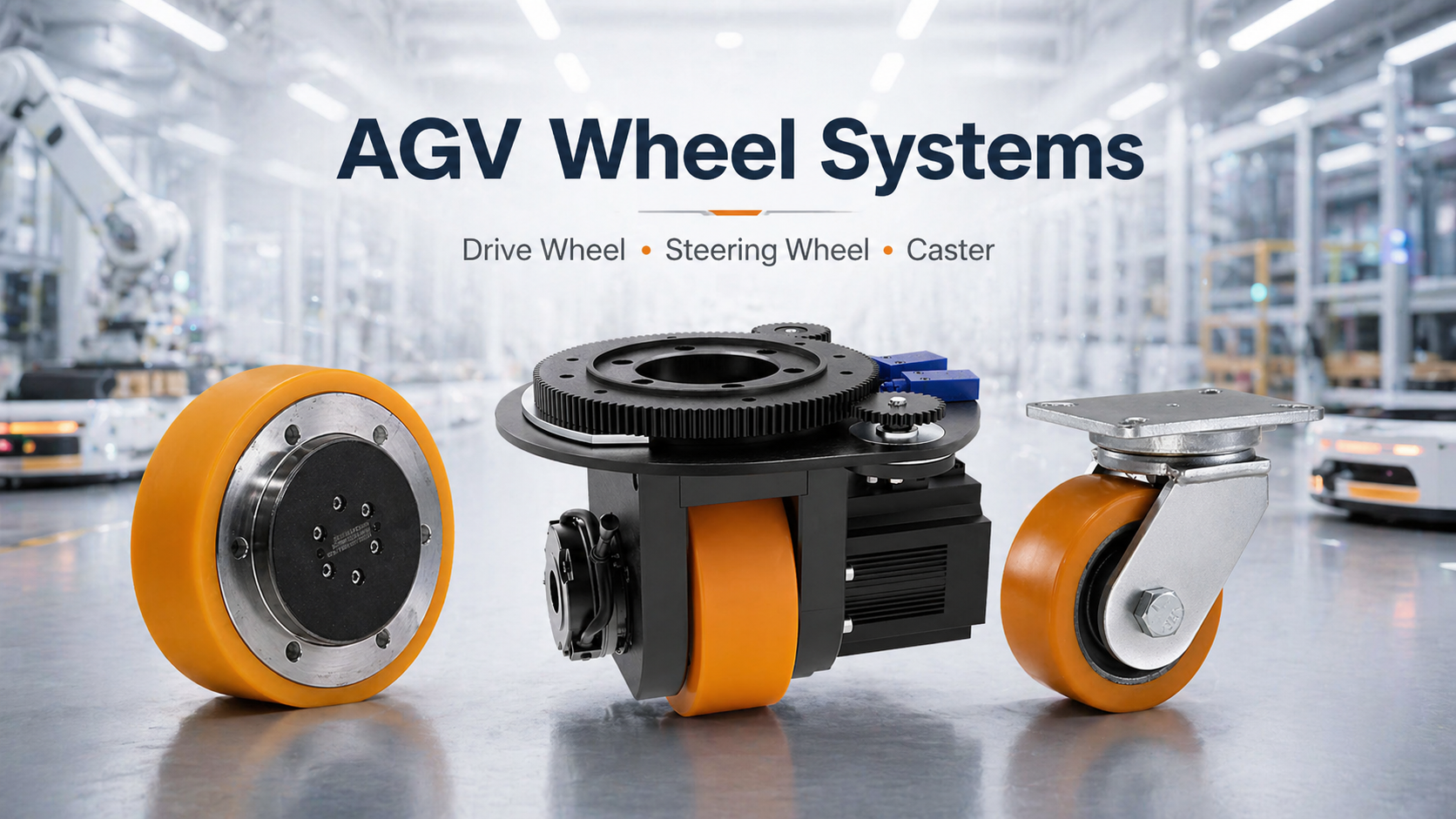
In modern intelligent manufacturing and factory automation, an AGV’s performance mainly comes down to its wheel system. AGV drive wheels, agv steering drive wheels, and agv casters perform different roles in traction, steering, and support, and together affect the AGV’s stability, positioning accuracy, load capacity, and overall cost.
From an engineering application perspective, this article revisits the technical characteristics, suitable application scenarios, and selection logic of these three components, helping you to clearly decide when to use drive wheels, when to use steering wheels, and when to use casters in AGV travel system design and selection.
1. AGV Drive Wheels: The “Basic Power Unit” Built Around Cost-Effectiveness
In most light- to medium-duty AGVs, agv drive wheels are the core units that provide traction power. A differential drive system achieves vehicle steering through the speed difference between the left and right drive wheels, making it one of the most widely used mobility configurations today.

1.1 Motion Logic of Differential Drive Wheels
The motion of a differential-drive AGV is determined by the combined linear velocities of its left and right drive wheels. The vehicle’s forward linear velocity depends on the average of the two wheel speeds, while its angular velocity depends on the speed difference between them. By adjusting the speed magnitude and direction of each wheel, the AGV can achieve straight-line travel, curved turning, and in-place rotation.
The basic kinematic model can be expressed as:
v = vL + vR 2
ω = vR - vL B
where vL and vR are the linear velocities of the left and right drive wheels, v is the linear velocity of the vehicle body, ω is the angular velocity of the vehicle, and B is the center distance between the two drive wheels.
When the left and right wheels rotate at the same speed but in opposite directions, that is:
vL = -v
vR = v
the AGV rotates in place about its own center. In this case, the angular velocity becomes:
ω = 2v B
This model forms the foundation of motion control, path tracking, and odometry calculation for differential-drive AGVs. It also means that such systems are relatively sensitive to wheel speed consistency, floor traction conditions, and wheel slip. In practical applications, encoder data is often combined with IMU or navigation system feedback to improve motion accuracy and compensate for accumulated errors.

1.2 Technical Characteristics of Differential Drive Wheels
The main advantages of differential drive include:
-
A simple structure, with no need for an independent steering mechanism. Full motion control can be achieved using only two drive motors, which keeps system implementation difficulty and cost relatively low;
-
A relatively mature control logic, with lower integration complexity in both hardware and software, while maintenance and troubleshooting are also more straightforward;
-
In-place rotation capability, which gives the AGV a certain level of flexibility in confined spaces and allows it to meet the needs of most basic material-handling scenarios.
However, its limitations are also quite clear:
-
Steering relies entirely on wheel speed difference, so wheel speed errors or differences in floor friction can be amplified, affecting the vehicle’s trajectory tracking accuracy and repeatable positioning stability. This is especially noticeable under high-speed or heavy-load conditions, where side slip or path deviation is more likely to occur;
-
It is relatively sensitive to floor flatness, traction conditions, and wheel consistency, meaning that changes in site conditions can directly affect operating performance;
-
It cannot achieve true lateral or diagonal movement, which gradually becomes a limitation in high-precision, high-flexibility production lines or complex obstacle-avoidance scenarios.
1.3 Typical Application Scenarios for Differential Drive Wheels
Overall, differential drive wheels are better suited for light- to medium-load applications, with typical payloads usually below 500 kg. They are especially suitable for projects with relatively moderate positioning accuracy requirements, where cost control, system maturity, and ease of maintenance are the main priorities. This type of drive solution is also well matched to standardized point-to-point material handling tasks in which lateral movement and complex path maneuverability are not critical.
In practical applications, differential drive is commonly used in AGV systems based on magnetic navigation, QR code navigation, or basic laser navigation, particularly in projects that are sensitive to automation upgrade costs. In these scenarios, differential drive wheels combined with caster wheels remain a mature, easy-to-control, and cost-effective mobility solution. Although their motion flexibility is limited, they still provide strong practical engineering value in a large number of standardized material-handling projects.
2. AGV Steering Wheels: An Advanced System That Combines Driving and Steering
A steering wheel module is a highly integrated unit that combines driving, steering, and load-bearing functions. It is also one of the key technologies that allows an AGV to move more flexibly, position more accurately, and handle more complex paths. Compared with a traditional differential drive setup, a steering wheel not only provides driving force, but can also control its steering angle independently. This gives the vehicle much more freedom of movement and makes it better suited for demanding working environments. As factories continue to move toward flexible manufacturing, narrow aisle operation, and high-precision docking, steering wheels have become an important choice for mid- to high-end AGV chassis systems.

2.1 Structure and Role of AGV Steering Wheels
In simple terms, a steering wheel is a highly integrated module made up of a drive motor, a steering motor, a high-rigidity gearbox, a brake mechanism, the wheel itself, and a high-precision encoder. It can handle driving, steering, and supporting the load all at the same time. Its main functions include:
-
providing drive torque to move the AGV forward, backward, and at different speeds;
-
controlling the steering angle independently for smooth and accurate direction changes;
-
carrying part or all of the vehicle load and helping distribute structural stress;
-
working together with other wheel modules to achieve sideways movement, diagonal travel, and in-place rotation.
Compared with a traditional differential drive system, a steering wheel is more complex in structure and places higher demands on the control system, mechanical rigidity, and assembly accuracy. But in return, it offers much better motion performance, higher control accuracy, and stronger adaptability, which is why it is often seen as a more advanced form of AGV drive system.
2.2 Main Advantages of AGV Steering Wheels
-
Higher freedom of movement:
Steering wheels allow an AGV to move sideways, diagonally, and rotate in place. This gives the vehicle much better maneuverability in tight spaces and makes path planning much more flexible. They are especially useful in narrow aisles, dense workstations, and environments with complex obstacle avoidance needs. -
Better control accuracy:
Because each steering wheel can control its own angle, the AGV can follow paths more accurately. When combined with high-precision encoders, servo systems, and motion control algorithms, steering wheels can achieve very accurate positioning, repeated docking, and stable operation in high-speed production lines. -
High level of modular integration:
A steering wheel combines driving, steering, and support functions into one module. This makes chassis design more standardized and easier to scale. For AGV manufacturers, this kind of modular setup makes system integration, product selection, and later maintenance more convenient, while also helping shorten development time. -
Wide load range:
Steering wheel products are available for everything from light-duty underride AGVs to heavy-duty platforms carrying several tons. In heavy-load applications especially, steering wheels have become a mainstream choice because they offer stronger load capacity and more stable control. -
Better for complex working conditions:
In applications that require frequent turning, accurate positioning, multi-stop operation, or precise docking with automation equipment, steering wheels have clear advantages over differential drive. They are simply better suited for flexible manufacturing environments where path and posture control matter a lot.
2.3 Engineering Development and Trends of AGV Steering Wheels
In the early stage, steering wheels had some obvious disadvantages in terms of size, cost, and ease of use. These mainly included:
-
relatively high installation height, often above 250 mm, which conflicted with the low chassis space needed by underride AGVs;
-
strong dependence on imported core components such as servo systems, gearboxes, and encoders, which made the overall cost quite high;
-
less mature control algorithms and system coordination, so in many cases they were only used for simple transport tasks and their full omnidirectional capability was not fully utilized;
-
low product standardization, which meant different projects often required different designs, increasing development and maintenance costs.
In recent years, as AGVs and AMRs have been used more widely in manufacturing and logistics, steering wheel products have gradually evolved toward lower height, smaller size, modular design, platform-based development, and higher integration. Installation height can now often be controlled within 200 mm, or even lower, making these modules much better suited for underride and low-profile AGVs. At the same time, matching servo drives, absolute encoders, and motion control solutions have become much more mature, which further improves control response, positioning accuracy, and overall system stability.
Looking ahead, the main development trends for steering wheels will likely focus on:
-
lower installation height and more compact design;
-
more highly integrated drive-and-steering structures;
-
more accurate closed-loop control and status feedback;
-
stronger platform compatibility and module standardization;
-
better reliability for heavy-load, high-speed, and high-throughput applications.
2.4 Typical Applications of AGV Steering Wheels
Today, steering wheels are already widely used in the following applications:
-
Underride, lifting, and jacking AGVs/AMRs: where chassis space usage, maneuverability, and steering performance are important;
-
High-precision manufacturing fields such as automotive body lines, 3C electronics assembly, new energy battery production, and semiconductors: where repeated positioning accuracy, docking accuracy, and running stability are critical;
-
Heavy-duty AGVs carrying several tons: where load capacity, drive torque, and control precision all need to be strong;
-
Narrow aisles, high-density storage areas, and flexible production lines: where more flexible path planning and better space adaptability are needed;
-
Applications requiring coordination with automation equipment: such as automatic loading and unloading, workstation docking, and assembly transfer, where stopping accuracy and motion consistency are very important.
Overall, steering wheels do cost more and are more complex than differential drive systems, both in structure and in control. But they offer clear advantages in movement flexibility, positioning accuracy, and adaptability to complex working conditions. For AGV projects that require high flexibility, high precision, and high load capacity, steering wheels are no longer just an optional upgrade. In many cases, they are becoming one of the core chassis solutions.
3. AGV Caster Wheels: The Small Supporting Part That Still Matters
Caster wheels do not provide driving power, but as part of the AGV’s follow-up support system, their design has a direct impact on overall running smoothness, service life, and user experience. Especially in differential-drive or multi-wheel chassis systems, caster wheels may look like secondary parts, but they often make the difference between a vehicle that runs smoothly and one that does not.

3.1 Key Design Parameters of Caster Wheels
One of the first things to consider is installation height consistency. Caster wheels and drive wheels or steering wheels should stay on the same load-bearing plane as much as possible. In most cases, the installation height difference is usually controlled within 2 mm to avoid wheel suspension, local overloading, or uneven force distribution, all of which can affect running stability and wheel life.
Load safety margin is another important point. The rated load of each caster should not be selected only based on simple average load distribution. In real projects, it is common to leave about 20% extra safety margin to handle shock loads, uneven floors, and dynamic load shifts.
Wheel diameter and wheel width also matter a lot. In general, a larger wheel diameter gives better obstacle-crossing ability and lower rolling resistance. A wider wheel provides a larger contact area, lower ground pressure, and better floor protection, while also helping reduce slipping.
In compact chassis designs, the swivel space of the caster also needs to be checked to avoid interference during turning. A common reference formula is:
Rrotate = sqrt((Lwheel / 2)^2 + Hinstall^2)
where Lwheel is the wheel diameter and Hinstall is the installation height. This can be used as a practical reference when planning multi-wheel layouts, installation clearance, and local obstacle avoidance.
3.2 Material and Structure Selection
Different caster materials fit different working conditions. Polyurethane (PU) is quiet and wear-resistant, so it works well in clean indoor environments. Rubber offers better grip and is more suitable for rougher floors or applications that need some vibration absorption. Nylon or other hard plastics have higher rigidity and good wear resistance, which makes them more suitable for heavy-duty or long-term static-load conditions.
As for structure, fixed casters help improve straight-line stability, while swivel casters provide better turning flexibility and can help reduce uneven loading during cornering. In real AGV projects, a combination of fixed and swivel casters is often used to balance stability and flexibility.
3.3 Typical Uses of Caster Wheels
Caster wheels are mainly used as auxiliary follow-up support wheels in many AGV chassis designs, helping distribute the load and keep the vehicle stable. In light-duty towing AGVs, they can also be part of a fully passive wheel system. In heavy-duty equipment, caster wheels are often used as auxiliary load-bearing wheels working together with the main drive system to improve overall stability and reliability.
Overall, caster wheels may not directly define the AGV’s active motion capability in the way drive wheels or steering wheels do, but they are still very important in support, follow-up movement, load distribution, and turning coordination. If caster wheel selection and layout are done well, the AGV will run more smoothly and last longer. If not, even this “supporting” wheel can become a weak point in the whole system.
4. Wheel Selection Guide
-
If cost is the priority and accuracy requirements are relatively low, choose differential drive wheels + swivel casters. This solution has a simple structure and lower cost, and is suitable for light- to medium-duty basic material handling and early-stage navigation systems.
-
If installation space is limited and higher positioning accuracy is required, choose steering wheels + fixed casters. This combination offers better motion flexibility and positioning accuracy, making it suitable for high-precision production lines, narrow aisles, and accurate docking applications.
-
If the application involves heavy loads and high-throughput handling, choose multiple steering wheels + high-load caster wheels. This setup can support larger payloads while maintaining control performance and structural stability.
Work with HKT Robot: Your Reliable Partner in AGV/AMR Components
Founded in 2013, HKT Robot specializes in the R&D, manufacturing, and sales of core components for mobile robots, including AGV/AMR drive wheels, motor controllers, differential wheel units, gear motors, and servo motors. Backed by solid engineering strength, reliable product quality, and competitive pricing, we are committed to providing stable and practical drive solutions for customers in the global AGV and AMR industry.
With years of experience in mobile robot applications, HKT Robot understands the real demands of AGV and AMR systems in terms of load capacity, motion control, structural integration, and long-term operating reliability. We not only provide standardized products, but also support customized solutions based on different vehicle structures and application requirements.
Whether you are developing a light-duty warehouse robot, a heavy-load industrial AGV, or a high-precision AMR platform, HKT Robot can support you with dependable components, responsive service, and professional technical assistance. We aim to be more than just a supplier — we strive to be your long-term partner in building efficient, stable, and competitive AGV/AMR solutions.
Share:
AGV Vs AMR: Key Difference, Selection, And Applications
Common AGV Servo Drive Problems and How to Avoid Them