

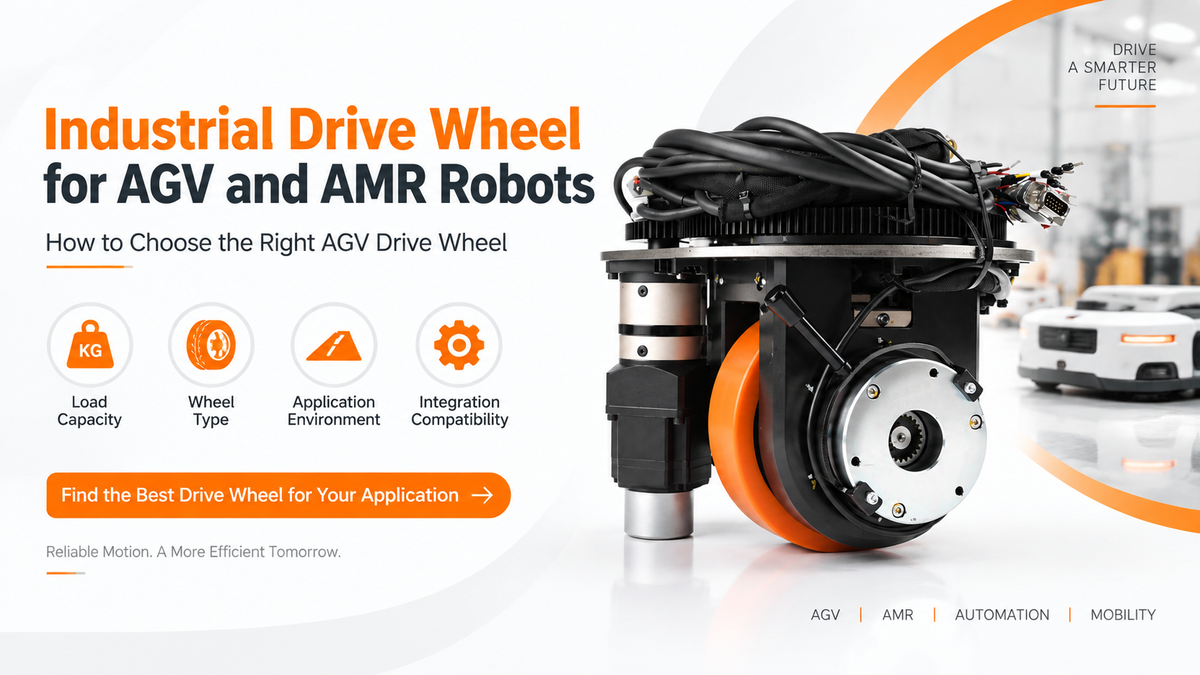
The drive system is one of the most important parts of an AGV or AMR robot. Although the wheel looks like a simple mechanical component, the performance of an industrial drive wheel directly affects the robot's movement accuracy, load capacity, stability, and operating lifetime.
For an AGV manufacturer, choosing the right AGV drive wheel is not only about finding a wheel that can carry the required weight. The drive wheel needs to work together with the motor, gearbox, encoder, controller, and the complete robot structure.
A small mistake in drive wheel selection can lead to problems during operation, such as wheel slipping, insufficient torque, unstable movement, higher noise, or inaccurate positioning.
With the increasing use of AGV and AMR robots in factories, warehouses, and industrial automation, reliable AGV wheels have become a key component for building efficient and stable mobile robot systems.
HKT ROBOT specializes in industrial drive wheel solutions for AGV and AMR applications, providing customized drive modules for different load requirements and working environments.

What Is an Industrial Drive Wheel for AGV and AMR?
An industrial drive wheel is a powered wheel system designed to move automated vehicles and mobile robots.
Unlike standard industrial wheels that only support the weight of equipment, an AGV drive wheel provides active driving force. It converts the power from the motor into movement and controls how the robot accelerates, moves, turns, and stops.
A complete AGV drive wheel module usually includes a drive motor, a gearbox, wheels, encoder, brake system, and steering mechanism (depending on design).
For AGV and AMR manufacturers, the drive wheel is not just a spare part. It is a core motion component that determines how smoothly and reliably the robot can operate.
A warehouse AMR transporting small packages and a heavy-duty AGV moving automotive components may both use AGV wheels, but their requirements are completely different. The wheel size, motor torque, gearbox ratio, and control system all need to match the actual application.
Why Is the Right AGV Drive Wheel Important?
Many customers initially focus on the payload of the robot. However, the actual working condition is more complicated.
An AGV does not only need to carry weight. It also needs to:
-
Start smoothly under full load
-
Maintain stable traction
-
Turn accurately
-
Operate for long hours
-
Adapt to different floor conditions
For example, a 5-ton AGV used in an automotive factory requires much higher torque and stronger traction than a 500kg warehouse AMR.
If the selected AGV drive wheel does not provide enough driving force, the robot may experience:
-
Wheel slipping during acceleration
-
Reduced positioning accuracy
-
Higher motor temperature
-
Increased mechanical wear
Therefore, a suitable industrial drive wheel needs to be selected based on the complete robot design, not only the vehicle weight.

How to Select the Right AGV Drive Wheel?
Load Capacity Is More Than Payload Weight
Load capacity is usually the first factor engineers consider when selecting an AGV wheel.
However, the actual load on each wheel is affected by many factors, such as total robot weight, maximum payload, number of wheels, weight distribution, floor condition, and acceleration and braking.
For example, two AGV robots may both have a 2-ton payload requirement, but their AGV drive wheel requirements can be completely different if one uses two drive wheels and the other uses four drive wheels.
A properly designed AGV wheel system should include enough safety margin to ensure stable operation over long periods.
At HKT ROBOT, we provide industrial drive wheel solutions for different applications, from compact AMR robots to heavy-duty AGV transportation platforms.
Motor Torque and Gearbox Selection Affect Real Performance
A common misunderstanding is that a higher-power motor always means better AGV performance.
In reality, the motor, gearbox, and wheel diameter need to work together.
The AGV drive wheel needs enough torque to:
-
Start the robot from a stop
-
Move heavy loads
-
Handle slopes or uneven surfaces
-
Maintain stable speed
For heavy-duty AGV applications, starting torque is often more important than maximum speed.
A correctly matched gearbox can increase output torque while maintaining efficient operation.
This is why experienced AGV wheel suppliers do not only provide a wheel. They help customers match the complete drive system according to the robot requirements.
Wheel Material Directly Influences Traction and Lifetime
The wheel material is another important factor that affects AGV performance.
Most indoor AGV and AMR robots operate on surfaces such as epoxy floors, concrete floors, factory floors, and warehouse floors. Different environments require different wheel materials.
A good AGV drive wheel needs to provide a balance between:
-
Traction
-
Wear resistance
-
Noise control
-
Floor protection
If the wheel material is not suitable, the robot may lose traction or create excessive wear during long-term operation.
For this reason, AGV manufacturers should consider the actual working environment before selecting AGV wheels.
Differential Drive Wheel or Steering Drive Wheel?
When designing an AGV or AMR robot, many engineers need to decide between differential drive and steering drive solutions.
A differential drive wheel system controls movement by adjusting the speed difference between the left and right wheels.
This design is commonly used for:
-
Warehouse AMR robots
-
Compact mobile robots
-
Indoor logistics systems
It provides a simple structure and good maneuverability.
A steering drive wheel combines driving and steering functions in one module.
This solution is often used for:
-
Heavy-duty AGV systems
-
Automotive manufacturing logistics
-
Large industrial transport robots
The advantage of a steering drive wheel is better flexibility and higher load capability.
There is no single solution that fits every AGV project. The correct choice depends on the robot structure, payload, working environment, and required movement accuracy.
Common Problems with AGV Drive Wheels
Why Does My AGV Wheel Slip?
Wheel slipping is one of the most common problems in AGV operation.
Possible reasons include:
-
Insufficient wheel pressure
-
Incorrect wheel material
-
Low motor torque
-
Poor weight distribution
-
Unsuitable driving parameters
A properly selected AGV drive wheel should maintain enough traction even under maximum load conditions.
Why Is AGV Positioning Accuracy Not Stable?
AGV positioning is affected by many factors, and the drive wheel plays an important role.
Possible causes include:
-
Encoder accuracy
-
Wheel wear
-
Uneven traction
-
Mechanical installation errors
For applications requiring precise docking or positioning, selecting the correct encoder and maintaining consistent wheel performance is important.
Why Does the AGV Drive Wheel Make Noise?
Noise problems can come from:
-
Gearbox design
-
Wheel material
-
Mechanical installation
-
Excessive load
For factories and warehouses, low-noise operation is becoming increasingly important, especially when AGV and AMR robots work together with operators.
Industrial Drive Wheel Applications
Industrial drive wheels are widely used in different automation applications.
In automotive factories, AGV wheels are commonly used for transporting:
-
Battery packs
-
Engine components
-
Production line materials
These applications usually require high load capacity and stable operation.
In warehouses and logistics centers, AMR drive wheels help robots move goods efficiently while maintaining accurate navigation.
For heavy industrial transportation, customized AGV drive wheel solutions are often required because standard products cannot always meet the load and installation requirements.
HKT ROBOT Industrial Drive Wheel Solutions
HKT ROBOT focuses on developing AGV and AMR motion solutions, including industrial drive wheels, steering drive wheels, differential drive wheels, motors, gearboxes, and controllers.
Unlike suppliers that only provide standard wheels, HKT ROBOT supports customers with complete drive system solutions.
Our engineering team works with customers to evaluate:
-
Robot payload
-
Required speed
-
Wheel configuration
-
Installation space
-
Floor conditions
-
Control requirements
We provide customized solutions for different AGV and AMR applications, from prototype development to mass production.
With experience in mobile robot drive systems, HKT ROBOT helps customers improve robot stability, reduce development time, and build reliable automation solutions.
How to Choose a Reliable AGV Wheel Supplier?
When selecting an AGV drive wheel supplier, price is only one factor.
A reliable supplier should understand the complete robot application.
Important questions include:
Can the supplier customize the drive wheel according to your design?
Can they provide motor and gearbox matching?
Can they support prototype testing and production?
Can they provide technical support after delivery?
For AGV and AMR manufacturers, choosing the right partner can reduce development risks and improve the long-term reliability of the robot.
Conclusion
The industrial drive wheel is a critical component for AGV and AMR robots.
A well-designed AGV drive wheel improves:
-
Movement stability
-
Load capability
-
Positioning accuracy
-
Operating lifetime
Whether you are developing a warehouse AMR, factory AGV, or heavy-duty mobile robot, selecting the right drive wheel solution is essential.
HKT ROBOT provides customized AGV wheel and AMR drive wheel solutions for global automation companies.
Need help selecting the right industrial drive wheel for your AGV or AMR project?
Send us your robot specifications, including payload, speed, wheel quantity, and application environment. Our engineering team can help evaluate and recommend a suitable drive wheel solution.
FAQs for Industrial Drive Wheels
1. What is an industrial drive wheel?
An industrial drive wheel is a powered wheel module used in AGV and AMR robots to provide movement and traction.
2. What is the difference between an AGV wheel and an AGV drive wheel?
An AGV wheel supports the robot movement, while an AGV drive wheel includes a motor-driven system to actively move the robot.
3. How do I choose an AGV drive wheel?
The selection depends on payload, speed, wheel quantity, motor torque, gearbox ratio, floor condition, and control requirements.
4. Can HKT ROBOT customize AGV drive wheels?
Yes. HKT ROBOT provides customized industrial drive wheel solutions based on robot structure and application requirements.
Share:
How To Size An AGV Drive System: A Practical Guide Based On Payload, Speed And Operating Conditions