

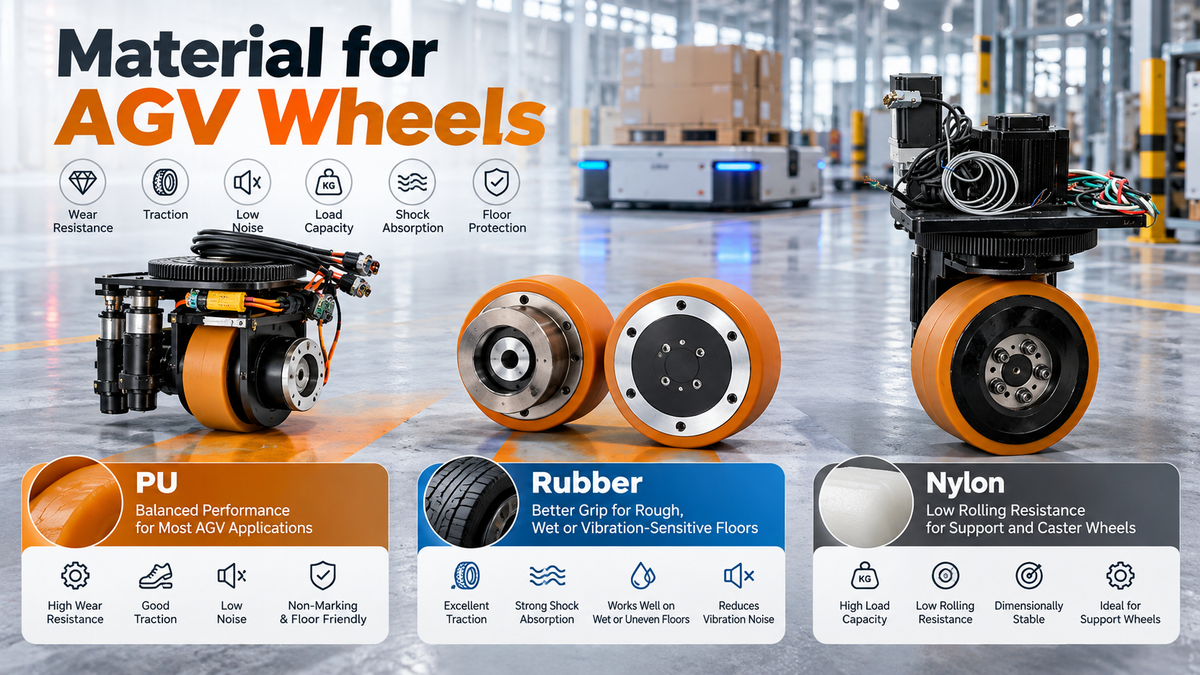
Let's face the reality, the wheel material used on an AGV may look like a small detail, but it directly affects traction, noise, wear, motor load, positioning stability, and even battery consumption.
For most indoor AGVs, polyurethane is usually the most balanced choice. Rubber performs better when grip and vibration absorption matter more, while nylon works well in support-wheel positions or on smooth floors where low rolling resistance is the priority. There is no single material that works best everywhere.
Here’s the thing: the right choice depends not only on vehicle load, but also on whether the wheel is a powered drive wheel or a caster, what type of floor it runs on, how often the AGV starts and stops, and how much deformation the drive system can tolerate.

PU vs Rubber vs Nylon for AGV Wheels
| Factor | PU | Rubber | Nylon |
| Typical Hardness | Shore A 70–95 | Shore A 50–85 | Shore D 70–85 |
| Density | 1.15–1.25 g/cm³ | 1.10–1.30 g/cm³ | 1.13–1.15 g/cm³ |
| Typical Temperature Range | -30°C to 80°C | -20°C to 70°C | -40°C to 100°C |
| Traction | High | Very High | Low–Moderate |
| Wear Resistance | Excellent | Moderate | Excellent |
| Rolling Resistance | Low–Medium | High | Very Low |
| Shock Absorption | Good | Excellent | Poor |
| Noise Level | Low | Very Low | High |
| Load Capacity | High | Moderate | High |
| Floor Protection | Very Good | Good | Limited |
| Oil / Chemical Resistance | Good | Moderate | Good |
| Moisture Resistance | Depends on PU formulation | Good | Moderate* |
| Typical Drive-System Effect | Balanced torque and efficiency | Higher traction but higher motor load | Low resistance but higher slip risk |
| Best Use | Most indoor AGV drive wheels | Rough, wet, or vibration-sensitive routes | Casters, support wheels, smooth floors |
-
Nylon can absorb moisture, especially PA6 and PA66, so dimensional and mechanical changes should be considered in humid environments.
These values are general engineering references. Actual wheel performance also depends on tread formulation, diameter, tread thickness, hub design, operating load, speed, and floor condition.
PU: Most Common Choice for AGV Drive Wheels
Polyurethane is the most common choice for AGV and AMR drive wheels because it sits somewhere between rubber and nylon.
It is harder and more wear-resistant than typical rubber, but it still has enough elasticity to maintain useful traction and absorb some shock. For indoor AGVs running on epoxy or smooth concrete floors, this combination is usually hard to beat.
PU also performs well in frequent start-stop operation. That matters because an AGV drive wheel is not simply rolling. It must transfer acceleration torque, braking torque, and sometimes steering force into the floor.
A tread that deforms too much wastes energy. One that is too hard may lose grip.
PU gives designers room to adjust this balance through hardness.
For example, softer PU provides better damping and usually more grip, while harder PU reduces deformation and supports heavier wheel loads. HKT ROBOT agv drive wheel units commonly use PU hardness options around 75A, 80A, and 85A on some wheel series, allowing the tread to be selected according to load and operating conditions.
That is also why hardness should not be selected by vehicle weight alone. Wheel diameter, tread thickness, floor condition, acceleration, and the amount of normal force acting on the drive wheel all matter.

Rubber: Better Grip and Shock Absorption for Challenging Floors
Rubber has one major advantage: grip.
Its higher elasticity allows the tread to conform better to small floor irregularities, which can improve traction on rough concrete, ramps, dusty areas, or surfaces that occasionally become wet.
It also absorbs vibration very well. For AGVs carrying sensitive loads, or robots operating over joints and uneven floors, that can reduce shock transmitted into the chassis.
The trade-off is rolling resistance.
A softer rubber wheel deforms more under load. That means the motor may need to provide more torque just to maintain the same vehicle speed. Over a long duty cycle, this can increase current draw and reduce energy efficiency.
Rubber may also wear faster than PU in applications with frequent turning or high continuous loads.
So, sure, rubber can be the better material. But usually only when the route actually needs the extra traction or damping.
The HAGV comparison reaches a similar conclusion, positioning rubber mainly for rough, slippery, sloped, or vibration-sensitive routes rather than as the default material for every AGV.
Nylon: Practical Choice for Low-Resistance Support Wheels
Nylon is much harder than PU or rubber. It deforms very little and offers very low rolling resistance.
That can be useful for caster wheels, support wheels, or slow-moving platforms operating on smooth industrial floors. A hard nylon wheel can carry high loads without much compression, which also helps reduce rolling losses.
The limitation is traction.
Nylon does not conform to the floor the way rubber or PU does, so a powered nylon wheel may slip more easily during acceleration or braking. It also transmits more vibration into the chassis and can be noisier on hard surfaces.
This is why nylon is usually more suitable for support positions than for the main powered drive wheel.
Another point is moisture. Nylon, especially PA6 and PA66, can absorb water. So it is better to treat its moisture resistance with some caution instead of simply describing nylon as “non-absorbing.”
Wheel Material Also Affects Motor and Control Performance
Wheel material is not only a mechanical choice.
It changes how the entire drive system behaves.
A softer tread usually means more deformation. More deformation increases rolling resistance, which can raise motor current and torque demand.
A very hard tread reduces deformation, but traction can become less stable. Once the wheel starts slipping, encoder feedback no longer represents actual vehicle travel accurately.
That can affect:
-
straight-line accuracy
-
docking accuracy
-
odometry
-
braking distance
-
acceleration control
This is particularly important in differential-drive AGVs, where the motion controller assumes that wheel rotation corresponds closely to actual wheel travel.
HKT ROBOT also treats the drive wheel as part of a complete system rather than as an isolated component. Our existing drive-wheel guidance already considers motor torque, gearbox ratio, wheel diameter, floor friction, load distribution, and control requirements together.
Best Material for Different AGV Conditions
In most indoor AGV projects, PU is the safest starting point.
For smooth epoxy or concrete floors, PU generally offers a practical balance of traction, wear life, noise, and floor protection.
Rubber becomes more attractive when the operating route includes rough surfaces, ramps, occasional moisture, or vibration-sensitive loads.
Nylon makes more sense where the floor is smooth, rolling resistance must be minimized, and the wheel is mainly carrying load rather than transmitting drive torque.
For cleanrooms, non-marking PU is often preferred because it combines floor protection with more useful traction than nylon. For heavy support positions, both hard PU and nylon can work, depending on floor sensitivity and impact conditions.
HKT ROBOT: Selecting the Wheel as Part of the AGV Drive System
HKT ROBOT focuses on complete AGV and AMR drive solutions rather than treating the wheel as a standalone part.
Our product range includes steering drive wheels, differential drive units, planetary drive wheels, servo motors, servo drives, gearboxes, controllers, and lifting modules. The same AGV can behave very differently depending on how these components are matched.
For example, changing from a softer wheel to a harder PU tread may reduce deformation, but the result also depends on wheel load, gearbox ratio, motor torque, and acceleration settings.
Likewise, selecting a rubber drive wheel for better traction may require checking whether the motor and drive have enough torque margin to handle the higher rolling resistance.
Our wheel products cover different diameters, hardness options, load levels, and drive structures. HKT ROBOT steering-drive products also use PU or rubber tread options across different wheel diameters and load ranges.
This is where working with a complete drive-system supplier can make selection easier. Instead of choosing wheel material first and trying to make the motor fit afterward, the wheel, motor, gearbox, encoder, and drive can be evaluated together.
For a new project, the most useful information usually includes vehicle weight, load per wheel, target speed, floor type, slope, wheel diameter, duty cycle, and whether the wheel is used for driving or support.
Conclusion
There is no universal best wheel material for every AGV.
For most indoor powered drive wheels, PU offers the best overall balance of traction, wear resistance, floor protection, noise, and efficiency.
Rubber is better when grip and shock absorption are more important than rolling resistance.
Nylon works well for low-resistance support positions and high loads on smooth floors, but it is usually less suitable for powered drive wheels.
The final choice should be based on the complete drive system, not material alone. Wheel hardness, floor condition, load distribution, motor torque, gearbox ratio, and control strategy all affect how the AGV performs in real operation.
FAQs for AGV Wheel Materials
1. Can AGV drive wheels and caster wheels use different materials?
Yes. In many AGV designs, the drive wheel and caster do not need the same material. Drive wheels usually prioritize traction and torque transfer, while casters may focus more on low rolling resistance, load support, and swivel stability.
2. How does wheel hardness affect AGV performance?
Harder wheels deform less and usually support higher loads with lower rolling resistance, while softer wheels provide better grip and vibration absorption. The right hardness depends on load, floor condition, speed, acceleration, and wheel diameter.
3. Which AGV wheel material is better for epoxy floors?
For smooth epoxy floors, non-marking PU is often a practical choice because it combines good traction, wear resistance, low noise, and better floor protection than harder materials such as nylon.
4. How do I choose wheel material for a heavy-duty AGV?
Heavy-duty AGVs require more than just a high load rating. Wheel diameter, tread hardness, load per wheel, turning frequency, floor condition, and motor torque should all be considered together. Hard PU or nylon may suit support positions, while powered wheels still need sufficient traction.
5. When should an AGV wheel be replaced?
Replacement depends on wear, cracking, delamination, flat spots, loss of traction, abnormal vibration, and dimensional changes. For drive wheels, even moderate tread wear can affect wheel diameter and reduce straight-line or positioning accuracy.
Share:
AGV Wheel Motor: Integrated Drive Solutions for AGV and AMR
Servo Drives for AGV and AMR Systems: Applications and Configurations