

In modern logistics automation, AGV performance is no longer determined by a single component alone.
A motor, gearbox, or wheel may look suitable on paper, but the real question is whether the complete AGV drive solution truly matches the customer’s working conditions.
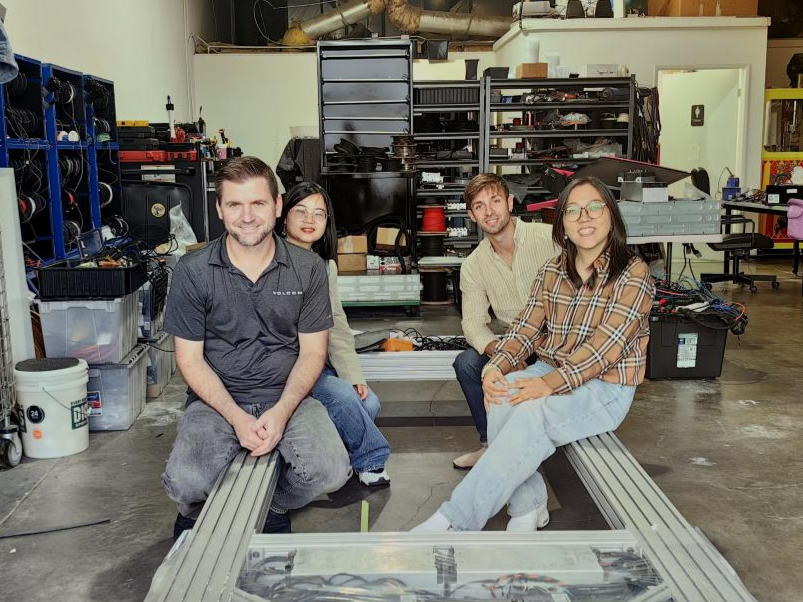
In January 2026, our team visited an American customer to better understand their AGV application and operating environment.
By observing the project on site and discussing the actual working conditions with the customer, we gained a clearer picture of the challenges behind the system requirements. The visit once again confirmed an important point: a reliable AGV drive solution must be built around real application needs, not just catalog parameters.
Seeing the Application in Person Changes the Evaluation
For AGV projects, many critical issues cannot be fully identified through drawings or basic specifications alone.
A customer may initially provide information such as load requirement, speed target, or installation space, but once we are on site, we can often see additional factors that directly affect long-term performance.
These factors may include continuous operation over long hours, uneven floor conditions, repeated start-stop movement, high-frequency steering, or the need for stronger traction under load.
In real factory environments, these details can significantly influence wheel wear, drive stability, gearbox matching, and maintenance frequency.
During this visit, we focused on how the AGV was being used in the actual material handling process. Combined with the customer’s feedback, it became clear that this project required more than a standard drive configuration.
The system needed to support not only load capacity, but also stable motion, efficient torque transmission, reliable traction, and long-term durability.
A well-matched AGV drive solution is not simply a combination of motor, gearbox, and wheel. It is a system-level answer to the customer’s actual load, floor, motion, and duty-cycle requirements.

From Detailed Communication to a More Practical Solution
What stood out during this visit was not only the application itself, but also the depth of the communication.
The customer was not simply asking for a standard product. He is an experienced engineer with strong knowledge of automotive R&D, machining, and project development, so the discussion quickly moved beyond basic specifications and focused on how the solution could truly fit his vehicle design and usage goals.
During the conversation, he shared several very specific concerns.
He was looking for a steering wheel solution that could be made lower and narrower, with expectations for 90-degree steering characteristics, 360-degree motion capability, and an integrated brake function. He also mentioned that he had previously tried a robotic wheel from a U.S. brand, but the wheel and controller were both too large, which resulted in unnecessary cost and poor fit for the project.
These details gave us a much clearer understanding of what mattered most to him.
Instead of simply recommending a standard configuration, we evaluated the project based on the actual structure, dimensional limits, motion requirements, and future volume plan.
By combining what we learned from the communication with the real application context, we were able to provide a more practical AGV drive solution that was better aligned with the customer’s project needs.
Our Optimization Suggestions for the Project
After reviewing the on-site conditions and discussing the customer’s requirements in detail, we proposed several directions for optimizing the AGV drive solution.
The first was to consider a heavy-duty steering wheel configuration better suited for high-load applications.
This was not only about increasing load capacity, but also about maintaining better vehicle stability during dynamic movement and reducing long-term structural stress.
The second was to further optimize the gearbox matching.
In AGV systems, a gearbox does much more than reduce speed and increase torque. It directly affects torque output, transmission smoothness, and response during acceleration, deceleration, and steering. A more suitable gearbox structure can help the AGV maintain stable performance even under demanding working conditions.
The third was to refine the PU wheel hardness based on the floor condition and usage pattern.
Wheel hardness should not simply be as hard as possible or as soft as possible. It needs to be balanced according to floor material, vehicle load, traction requirement, wear resistance, and running frequency. A more suitable hardness range can improve grip, reduce slipping, and support longer service life.

Why Standard Products Are Not Always Enough
This visit highlighted a reality we often see in AGV projects: in complex working environments, standard products may be good enough for basic movement, but they are not always ideal for long-term stability, efficiency, and lower maintenance cost.
For the customer, the real goal is not simply to make the AGV move. The goal is to keep it moving reliably, smoothly, and efficiently in daily operation.
That is why more AGV and AMR projects today are shifting from simple component purchasing to application-based drive solution customization. By combining early communication, on-site observation, and technical optimization, it becomes much easier to build a drive system that truly fits the customer’s real needs.
Final Thoughts
A valuable customer visit is more than a business meeting. It is often the starting point for better engineering decisions.
For AGV applications, real working conditions often determine the final logic behind drive system selection. Only by understanding the customer’s environment, load condition, and operation goals can we recommend a solution that performs well in practice, not just in theory.
At HKT-ROBOT, we believe that a better AGV drive solution starts with a better understanding of the application itself.
Through site visits, technical communication, and continuous optimization, we aim to provide drive systems that are more reliable, more efficient, and better matched to real industrial use.
Share:
Craftsmanship Without Borders: How HKT Robot Delivers Professional AGV Drive Wheel Solutions for the European Friend
More Than Product Delivery: How HKT Robot Remotely Helped a European AGV Customer Reduce Steering Wheel Noise