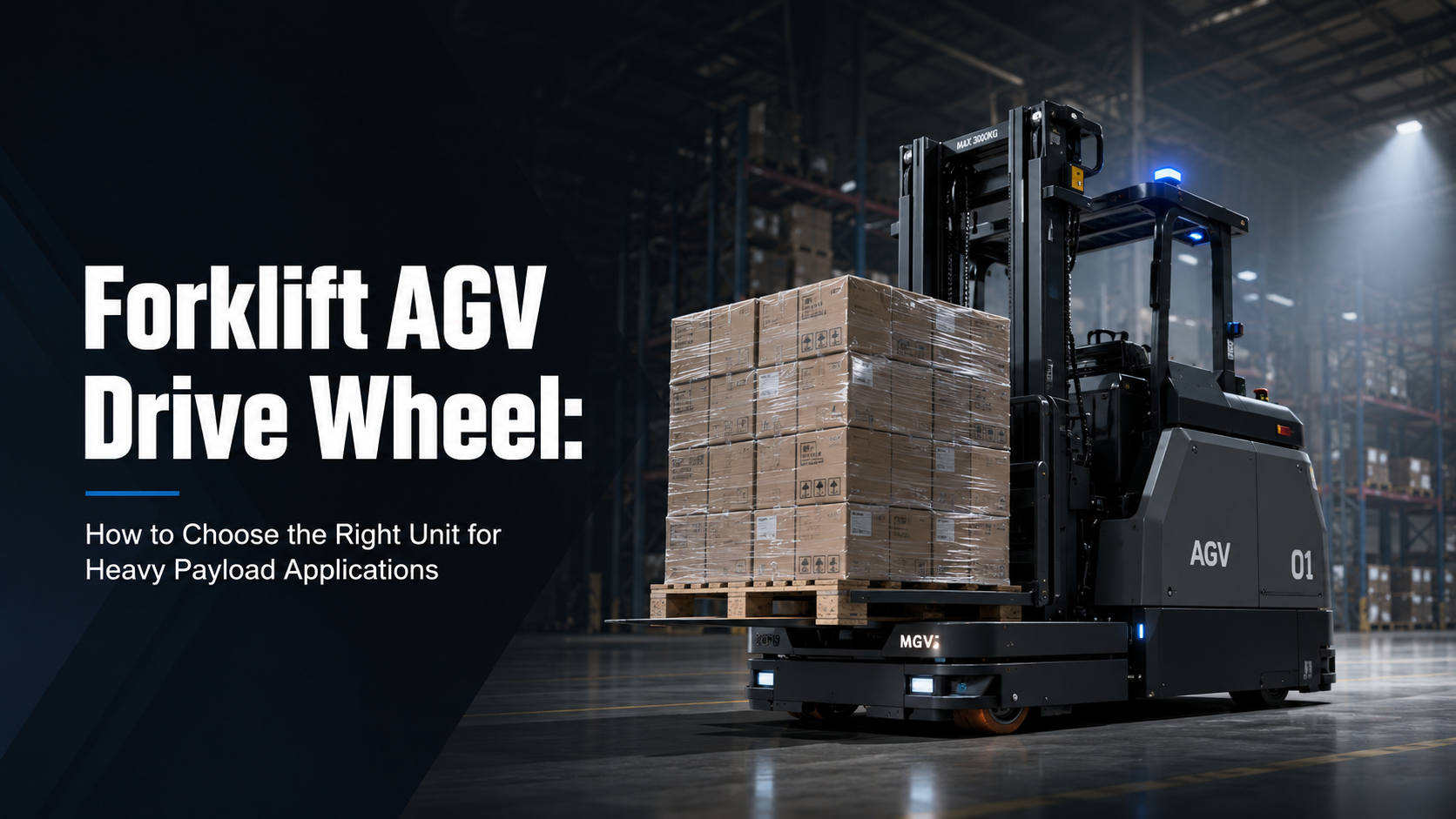
A forklift AGV carrying a 1,500 kg pallet load is not simply a larger version of a 300 kg shelf-moving AMR. The mechanical demands on the drivetrain scale non-linearly with payload — bearing loads, motor torque requirements, floor contact forces, and braking energy all increase in ways that make the drive wheel the most mechanically stressed component in the vehicle. Specify it correctly, and the drivetrain runs quietly for years. Specify it to light AMR standards, and the bearings, seals, and gear surfaces will communicate the error within months of production deployment.
This guide is written for mechanical engineers and system integrators developing forklift AGV platforms or qualifying drive wheel components for heavy payload automated guided vehicle programs. It covers the drive wheel architectures suited to forklift AGV applications, the specifications that matter most at high load levels, the differences between light and heavy payload drive systems, and the supplier criteria relevant to volume production sourcing.

What Defines a Forklift AGV and Why It Changes Drive Wheel Requirements
A forklift AGV is an automated guided vehicle designed to perform the functions of a powered industrial truck — pallet transport, rack storage and retrieval, load transfer between production and logistics areas — without a human operator. Payload capacities typically range from 1,000 kg to 3,000 kg, with some heavy industrial platforms exceeding this range.
These payload levels impose fundamentally different requirements on the drive wheel compared to light AMR applications. At 1,500 kg gross vehicle weight, the radial bearing load on a single drive wheel assembly can exceed 7,000 N under dynamic cornering conditions. Motor torque demand at start-up and on gradient surfaces can reach multiples of the steady-state running torque. Braking forces during emergency stops generate axial loads on the wheel hub that light AMR wheel assemblies are not designed to absorb.
The operating environment compounds these mechanical demands. Forklift AGVs operate in areas shared with racking systems, pedestrian traffic, and other vehicles. Floor surfaces in loading dock areas and cross-docking facilities are less uniform than in dedicated AMR zones. The drive wheel must maintain traction and steering precision across floor joints, dock leveler plates, and surface contamination from pallet debris and occasional liquid spills.
Drive Wheel Architectures for Forklift AGV Applications
Horizontal Steering Wheel
The integrated horizontal steering wheel is the dominant drive module architecture for forklift AGV traction drives. In this configuration, the drive motor is mounted with its axis horizontal within the wheel hub — parallel to the wheel's rolling axis — and drives the wheel through an internal planetary gearbox. A separate steering motor rotates the entire assembly around a vertical axis.
The horizontal motor orientation allows a wider, lower wheel profile than a vertical motor stack, distributing load across a larger bearing diameter and providing a more stable mounting footprint for heavy chassis integration. High-power versions — 2,200W and above — are available with single-wheel dynamic load ratings exceeding 2,000 kg, covering the payload range of most pallet-handling forklift AGV platforms.
The integrated design eliminates external shaft couplings and reduces the mechanical interface count between motor, gearbox, and wheel hub, improving drivetrain stiffness and reducing the potential for fretting wear at mechanical joints under high-load cyclic conditions.
Separate Traction and Steering Architecture
Some forklift AGV designs use a separate traction motor driving a fixed-axis wheel, with steering achieved through a dedicated steering actuator that pivots the entire wheel-motor assembly. This approach allows the traction motor to be sized independently of the steering actuator, which can simplify motor selection for very high torque applications where a single integrated module would be mechanically large.
The trade-off is increased mechanical complexity, more mounting points on the chassis, and larger overall drivetrain envelope. For most forklift AGV applications in the 1,000 to 3,000 kg range, the integrated horizontal steering wheel offers better packaging and comparable mechanical performance.
Multi-Wheel Drive Configurations
Very heavy platforms — typically above 3,000 kg or for applications requiring high traction force on gradients — may use two or more driven steering wheel assemblies. This distributes the load across multiple wheel contact patches, reduces per-wheel bearing loads, and improves traction by increasing the total driven contact area. Control complexity increases proportionally, requiring the vehicle controller to coordinate torque and steering commands across multiple drive axes without inducing tire scrub or chassis twist.

Key Specifications for Forklift AGV Drive Wheels
Load Capacity and Service Factor
Dynamic load capacity — the maximum continuously applied radial force the wheel bearing assembly can sustain — is the primary sizing parameter for forklift AGV drive wheels. This figure must be evaluated against the actual wheel load under the vehicle's maximum gross weight, including dynamic factors for cornering, gradient operation, and acceleration.
For a single-drive-wheel forklift AGV carrying 1,500 kg total gross weight, the static wheel load may be 800 to 1,000 kg on the traction wheel depending on chassis geometry and weight distribution. Dynamic cornering loads can multiply this by 1.3 to 1.8. Applying a service factor of 1.5 to the calculated peak dynamic load gives a conservative minimum bearing rating. Drive wheels specified at or below the static load without dynamic margin are systematically undersized for forklift AGV duty.
Motor Power Rating
Motor power determines the maximum traction force and speed the drive wheel can deliver. For forklift AGV applications, drive motor power typically ranges from 750W for lighter platforms to 2,200W and above for high-payload or gradient-capable vehicles. Power rating alone is insufficient — the motor's torque-speed curve must be matched to the gear ratio and wheel diameter to achieve the required tractive force at the target vehicle speed without operating the motor outside its continuous duty region.
Gear Ratio for High-Torque Applications
Forklift AGV drive wheels require higher gear ratios than light AMR applications to multiply motor torque to the levels needed for heavy load starting and gradient operation. Gear ratios in the 40:1 to 60:1 range are common for forklift AGV traction drives, compared to 20:1 to 35:1 for lighter platforms. The planetary gearbox integrated into the horizontal steering wheel must be rated for the continuous and peak output torque at the selected ratio, with a fatigue life adequate for the vehicle's operational cycle count over its design service life.
Wheel Material and Floor Compatibility
The wheel tread material affects traction, noise, floor marking, and load distribution across the contact patch. Polyurethane treads are standard for indoor logistics applications — they offer good traction on smooth concrete, low floor marking tendency, and adequate shock absorption for floor joints and dock levelers. Shore hardness selection involves a trade-off: softer compounds improve load distribution and reduce peak floor pressure, but wear faster under heavy loads and high cycle rates. Harder compounds extend wear life but increase floor contact pressure, which is relevant for facilities with floor load limits or sensitive surface coatings.
IP Rating and Environmental Protection
Forklift AGVs operate in environments where floor contamination, pallet debris, shrink wrap fragments, and occasional liquid spills are routine. The drive wheel assembly — particularly the steering motor, encoder, and gearbox seals — must be rated for these conditions. IP54 is a minimum for general indoor forklift AGV use. Dock areas, cold storage facilities, and any environment with floor washing or high humidity require IP65 or above. Inadequate sealing of the steering motor or encoder connector is a common root cause of premature drive wheel failure in forklift AGV deployments.
Mounting Interface and Chassis Integration
The drive wheel mounts to the AGV chassis via a flange that must carry the full structural load of the vehicle in all operating conditions including emergency braking and worst-case cornering. For forklift AGV applications, the mounting flange bolt pattern, bolt size, and flange thickness must be sized for the actual load case — not scaled from a light AMR design. The steering axis bearing, which carries the radial and axial loads of the entire drive assembly during rotation, must be rated for the combined static and dynamic loads at the maximum gross vehicle weight.
How Forklift AGV Drive Wheels Differ from Light AMR Wheels
The differences between a forklift AGV drive wheel and a light AMR drive module are not simply a matter of scale. Several design elements are qualitatively different rather than proportionally larger.
Bearing selection moves from standard radial ball bearings to angular contact or tapered roller bearings capable of handling combined axial and radial loading. Gear surface treatments shift from standard case hardening to deeper carburizing or nitriding to handle higher contact stresses over longer service life. Seal designs move from simple lip seals to compound sealing arrangements that maintain exclusion performance under the higher pressure differentials generated by the larger wheel assemblies in motion.
The steering mechanism must handle significantly higher restoring torques — the resistance to steering rotation that increases with vertical load on the wheel — requiring a larger steering motor and reduction stage than equivalent light AMR units. Control systems must account for the longer mechanical time constants of heavier rotating assemblies, adjusting steering response tuning to avoid instability that would not appear in lighter vehicles.
Common Specification Mistakes on Heavy Payload AGV Programs
Applying light AMR load ratings to forklift AGV chassis designs. Engineers familiar with AMR development sometimes apply the same drive wheel family to a new forklift AGV program, scaling the chassis up but keeping the wheel specification unchanged. The result is a drive wheel operating well above its rated load from day one of production deployment, with bearing and seal failures appearing within the first few months of operation.
Calculating wheel load from payload only, ignoring chassis weight. Gross vehicle weight includes chassis, battery pack, lifting mechanism, and control electronics in addition to rated payload. On a forklift AGV, chassis and battery weight often represents 40 to 60 percent of total gross weight. Drive wheel load calculations based on payload alone systematically underestimate actual wheel loads by a significant margin.
Specifying standard polyurethane hardness without evaluating floor pressure limits. Facilities with polished concrete, raised floors, or specific floor load restrictions may require softer compound wheels to distribute load across a wider contact patch and reduce peak pressure. Using standard hardness compounds in these environments causes floor damage and increases drive wheel wear rate through higher contact stress concentration.
Ignoring steering torque requirements under full load. Steering a heavy forklift AGV drive wheel under full payload load requires significantly more torque than steering the same wheel unloaded. Steering motor sizing based on no-load or reduced-load test conditions results in drive wheels that struggle to complete steering maneuvers at full gross weight, causing speed reductions, control errors, and premature steering motor wear.

What to Look for in a Forklift AGV Drive Wheel Supplier
Documented heavy load test data. Suppliers of forklift AGV drive wheels should be able to provide bearing life calculations or test data at the rated load levels, not just catalogue specifications. A bearing L10 life calculation at the application load confirms that the specified wheel will meet the vehicle's design service life under realistic operating conditions.
High-power and high-load product range. Not all AGV drive wheel suppliers manufacture products in the power and load range required for forklift AGV applications. Confirm that the supplier's standard product range includes the power ratings, gear ratios, and load capacities needed for your platform before entering detailed technical evaluation.
Application engineering for heavy-payload integration. Forklift AGV chassis integration involves structural load path analysis, bearing preload specification, and steering torque budgeting that require engineering input beyond standard product selection. Suppliers with application engineers who understand heavy-payload AGV integration provide more reliable guidance than catalogue-only distributors.
Customization for non-standard chassis geometry. Forklift AGV chassis designs vary significantly across platforms. Mounting flange geometry, steering axis height, wheel diameter, and tread width often require customization to match the chassis design and floor clearance requirements. Suppliers capable of customization within reasonable lead times and minimum order quantities are necessary for production programs with application-specific requirements.
FAQ
What load capacity should I specify for a forklift AGV drive wheel?
Calculate the maximum gross vehicle weight — payload plus chassis, battery, and all onboard equipment. Determine the proportion of that weight borne by the traction drive wheel based on chassis geometry and weight distribution. Apply a dynamic service factor of 1.5 to account for cornering, gradient, and braking forces. The resulting figure is the minimum dynamic load capacity to specify for the drive wheel bearing assembly. For a 2,000 kg gross weight vehicle with 60 percent load on the traction wheel, this gives a minimum rating of approximately 1,800 kg.
What motor power is typical for a forklift AGV drive wheel?
Motor power for forklift AGV traction drives typically ranges from 750W for lighter pallet mover platforms to 2,200W and above for full counterbalance or reach truck AGV equivalents. Power selection depends on required vehicle speed, gradient capability, acceleration performance, and duty cycle. Higher power ratings also provide derating margin that extends motor service life in continuous heavy-load operation.
Can the same drive wheel be used on both forklift AGVs and standard warehouse AMRs?
Not reliably. Drive wheels designed and rated for forklift AGV load levels are mechanically overspecified for light AMR applications — adding unnecessary cost and weight. More critically, light AMR drive wheels are mechanically underspecified for forklift AGV loads and will fail prematurely under heavy payload conditions. Application-appropriate specification is necessary for both reliability and cost efficiency.
What wheel tread material is recommended for indoor forklift AGV use?
Polyurethane is the standard tread material for indoor forklift AGV applications on smooth concrete floors. Shore hardness selection — typically between 80A and 95A — depends on load level, speed, floor surface condition, and floor pressure limits. Softer compounds improve load distribution but wear faster; harder compounds extend wear life but increase floor contact pressure. Supplier application engineers can recommend hardness based on specific load and floor conditions.
What IP rating is required for a forklift AGV drive wheel in a loading dock environment?
Loading dock environments typically require IP65 as a minimum due to exposure to outdoor humidity, vehicle exhaust, cleaning operations, and debris from inbound freight. Drive wheel assemblies rated only to IP54 will experience contamination ingress at the steering motor and encoder, leading to premature failure in dock-area deployments. Confirm IP rating testing methodology with the supplier — some ratings reflect testing on the housing only and do not cover connector and cable entry points.
Conclusion
The forklift AGV drive wheel is the component where the performance gap between correctly specified and approximately specified is most visible and most costly. At the load levels typical of pallet-handling and rack-storage forklift AGV applications, bearing ratings, gear surface durability, seal design, and motor torque capacity all require specification against actual heavy-payload operating conditions — not extrapolation from light AMR design practice.
For engineering teams developing forklift AGV platforms, investing in drive wheel specification rigor at the design stage — accurate load calculation, dynamic service factor application, environmental sealing confirmation, and supplier capability evaluation — prevents the field failures and unplanned maintenance costs that consistently characterize programs where these steps were compressed or skipped.

Paylaşmak:
AGV Servo Drive Selection Guide: Key Specifications and What to Look For