

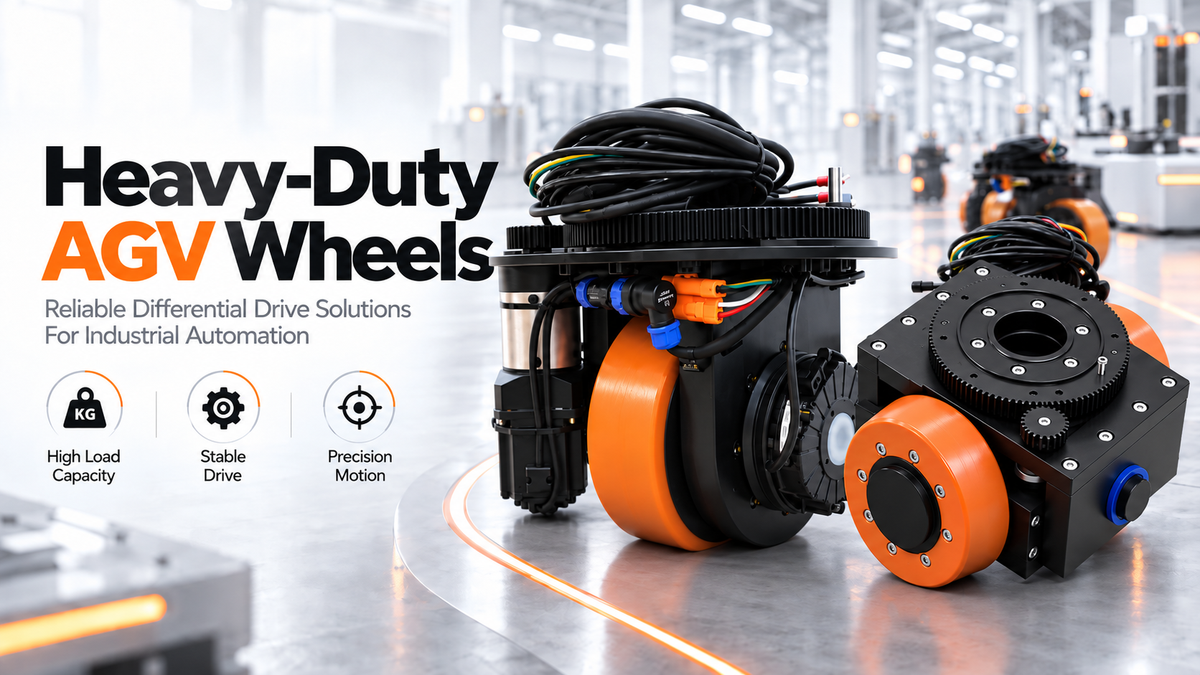
Heavy-duty AGVs or AMRs often operate under conditions where a small wheel-selection mistake can turn into a much larger system problem. A wheel that looks sufficient on paper may still struggle with slip, heat, unstable steering, or premature wear once the AGV starts moving several tons of load through real factory conditions.
The reason is simple: heavy-load operation changes more than just the force on the wheel. Acceleration, braking, turning, floor condition, operating hours, and traction all affect how the drive system performs. For this reason, selecting the right heavy-duty AGV wheel requires a closer look at how the wheel will actually work inside the vehicle.

What Makes an AGV Wheel Heavy Duty?
A heavy-duty AGV wheel is designed to handle higher loads, greater drive torque, and longer operating cycles than a standard AGV wheel. It typically uses a stronger wheel core, high-capacity bearings, durable tread materials, and a drive structure built for continuous operation under demanding conditions.
What makes a wheel truly “heavy duty” is not only its rated load. Torque capacity, wheel diameter, tread performance, steering resistance, bearing strength, and duty cycle all affect real-world performance. These factors become increasingly important as vehicle weight rises.
For example, a larger wheel can improve ground clearance and rolling performance, but it also changes the torque required at the wheel. A higher-power motor may provide more output, but if the tire cannot transfer that force effectively to the floor, the result may still be wheel slip rather than better performance.
So, selecting heavy-load AGV wheels should be based on the complete operating requirements of the vehicle, not by load rating alone.
Common Applications for Heavy-Load AGV Wheels
Heavy-duty AGV wheels are used where standard mobile robot components are no longer sufficient.
Typical examples include automotive production lines, steel plants, battery factories, aerospace assembly, mold handling, large warehouse systems, and heavy equipment manufacturing.
In these environments, the wheel system must do more than simply support weight. It also needs to provide enough traction during starting and braking, maintain stable steering under load, and withstand continuous operation without excessive wear or heat buildup.
The heavier the vehicle becomes, the more important the overall drive configuration is. Wheel type, motor torque, reducer ratio, brake performance, and chassis layout all influence how reliably the AGV can move and turn. This is why heavy-load applications usually require a more systematic approach than standard AGV wheel selection.

Key Challenges in Heavy-Duty AGV Wheel Applications
The first challenge is load distribution. In a real AGV, vehicle weight is rarely distributed perfectly across all wheels. Acceleration, braking, cornering, uneven floors, and changes in the center of gravity can increase the load on one or more wheels. This means the basic calculation of total weight divided by wheel quantity is only a starting point.
Traction is another major issue. A heavy AGV may have enough motor torque but still fail to move smoothly if the wheel does not provide sufficient grip. Floor material, dust, oil, moisture, polyurethane hardness, and contact area all influence traction. This is especially important when the AGV starts under full load or operates on slopes.
Thermal performance also becomes more important as the load increases. High torque and continuous operation generate heat in the motor, reducer, brake, and bearings. A drive system that performs well during short tests may not perform the same way during continuous multi-shift operation.
Steering resistance is another common challenge. When a heavily loaded steering wheel rotates while carrying several tons, friction between the tire and floor can create high resistance. This increases stress on the steering motor, reducer, bearings, and polyurethane tread. For very heavy AGVs, chassis layout and wheel configuration become just as important as the wheel itself.
Polyurethane, Traction, and Wheel Structure
Polyurethane is widely used for AGV drive wheels because it offers a useful balance between wear resistance, load capacity, floor protection, and traction. However, not all polyurethane formulations perform the same way.
Harder compounds can support higher loads and usually provide better wear resistance, while softer materials may provide more grip and vibration absorption. The correct choice depends on the floor and operating conditions rather than simply choosing the hardest tread available.
The wheel core is equally important. Heavy-load wheels normally require a strong metal core and reliable bonding between the core and polyurethane. Bearing selection, machining accuracy, and hub structure also affect long-term stability under high loads.
For heavy-duty applications, tread material should therefore be considered together with wheel diameter, vehicle load, floor condition, required traction, and expected service life.
How to Select a Heavy-Duty AGV Wheel
The first step is to calculate the actual vehicle load: both the AGV's own weight and its maximum payload. Load distribution should then be reviewed based on the chassis layout and center of gravity.
After load requirements are clear, wheel diameter and installation space can be considered. Larger wheels can improve ground clearance and help the vehicle pass small floor joints or uneven areas. However, wheel diameter also affects output torque and vehicle speed, so it needs to be matched with the motor and gearbox.
Speed, slope, and duty cycle should be evaluated together. An AGV operating slowly on a flat warehouse floor has very different drive requirements from a vehicle moving heavy steel parts on ramps for 16 hours per day.
The table below shows the main information needed during heavy-duty AGV wheel selection:
| Parameter | Why It Matters |
| Vehicle Weight + Payload | Determines total working load |
| Load Distribution | Prevents local wheel overload |
| Required Speed | Affects motor speed and gear ratio |
| Wheel Diameter | Influences torque, speed, and ground clearance |
| Maximum Slope | Increases required torque and traction |
| Floor Condition | Affects tread material and grip |
| Duty Cycle | Influences heat generation and service life |
| Steering Method | Determines wheel configuration and steering load |
| Installation Space | Limits wheel and reducer structure |
| Voltage and Control | Affects motor, drive, brake, and system integration |
Matching Motor Torque, Gear Ratio, and Wheel Diameter
For a heavy-load AGV, the wheel cannot be selected separately from the motor and reducer.
The required drive torque depends on vehicle resistance, wheel radius, acceleration, slope, and total load. A larger wheel generally requires more torque to produce the same driving force, while a higher reduction ratio increases output torque but reduces vehicle speed.
This is why motor power alone does not tell the full story. Two systems with the same motor power can produce very different wheel torque depending on gearbox ratio and wheel size.
In practical design, the motor, reducer, wheel, brake, and control system should be matched as one drive unit. This reduces the risk of insufficient torque, excessive current, overheating, or poor speed performance.
AGV Steering Drive Wheels or AGV Differential Drive Units?
Both agv steering drive wheels and agv differential drive units can be used in heavy-duty AGVs, but the correct choice depends on vehicle architecture.
Steering drive wheels are useful when the AGV requires flexible movement and independent steering control. They are commonly used in forklifts, omnidirectional platforms, and large AGVs that require precise directional control.
Agv differential drive units can simplify some chassis designs by controlling direction through different wheel speeds. For heavy-load systems, they can provide high drive torque and stable movement without a separate steering mechanism.
The decision should not be based only on load capacity. Turning radius, installation height, vehicle length, required movement direction, control strategy, and floor condition should all be considered.

How to Choose a Heavy-Duty AGV Wheel Manufacturer
A suitable heavy-duty AGV wheel manufacturer should provide more than a load rating. Product data should include practical parameters such as wheel diameter, rated load, output torque, motor power, gear ratio, speed, brake configuration, and encoder or control options. Without these values, it is difficult to evaluate whether the drive unit is suitable for a real vehicle.
System capability also matters. Heavy-duty applications often require the wheel, motor, gearbox, brake, encoder, and controller to work together. A manufacturer that understands the complete drive system can provide more accurate matching and reduce integration problems during vehicle development.
Engineering support is another important factor. Before recommending a model, the supplier should understand the AGV weight, payload, speed, slope, floor condition, installation space, voltage, steering method, and operating cycle. This type of early technical review is more valuable than simply choosing the largest available wheel.
Heavy-Duty AGV Wheel Solutions from HKT ROBOT
HKT ROBOT has focused on AGV and mobile robot motion components since 2013. With years of expertise and a strong engineering team, we can support both standard products and customized heavy-duty projects. Our agv wheels range covers 550 to 5,700 kg load capacity per wheel, with reference towing applications reaching up to 10,000 kg.
Plus, we provide more than individual wheels. Our product range includes steering drive wheels, differential drive units, servo motors, servo drives, reducers, brakes, encoders, and related AGV motion components. This makes it possible to evaluate the wheel as part of a complete drive system rather than as an isolated part.
For customized projects, our engineering team can review payload, speed, wheel diameter, installation height, control requirements, and chassis structure before recommending a drive solution.
FAQs About Heavy-Duty AGV Wheels
1. What information should I provide when selecting a heavy-duty AGV wheel?
The most useful information includes total vehicle weight, maximum payload, target speed, wheel quantity, wheel diameter, floor condition, maximum slope, installation space, voltage, steering method, and expected operating hours. A chassis drawing is also very helpful for customized projects.
2. Can a heavy-duty AGV wheel be customized for an existing chassis?
Yes. Wheel diameter, mounting structure, motor, gearbox, encoder, brake, and other parameters can often be adjusted according to the existing vehicle design. The final solution depends on available installation space and performance requirements.
3. Does a higher load rating always mean a better wheel?
No. A wheel with a higher load rating may also be larger, heavier, or require more installation space. The correct wheel should match the actual load, torque, speed, floor, and chassis requirements.
4. How does floor condition affect AGV wheel selection?
Floor material and condition directly affect traction, tread wear, vibration, and rolling resistance. Smooth epoxy floors, concrete, expansion joints, slopes, dust, and oil contamination may require different polyurethane or wheel configurations.
5. What is the typical lead time for a customized heavy-duty AGV wheel?
Lead time depends on the level of customization, motor and reducer selection, wheel structure, and control requirements. Standard configurations can usually be evaluated faster, while fully customized drive assemblies require additional engineering and production time. HKT ROBOT can confirm the schedule after reviewing the technical requirements.
Conclusion
A heavy-duty AGV wheel should not be selected only by rated load. Dynamic load, traction, torque, wheel diameter, gearbox ratio, steering resistance, floor conditions, and duty cycle all affect real performance.
For high-load AGVs, the most reliable approach is to treat the wheel, motor, reducer, brake, and control system as one complete motion system.
If you are developing a heavy-duty AGV, AMR, automated forklift, or industrial transport platform, send us your vehicle weight, payload, target speed, floor condition, installation drawing, and control requirements. HKT ROBOT can help evaluate the drive configuration and recommend a suitable wheel system.
Paylaşmak:
AGV ve AMR Robotları için Endüstriyel Tahrik Tekerleği: Doğru AGV Tahrik Tekerleği Nasıl Seçilir
AGV Drive Motor Solutions: 4 Common Options Explained