

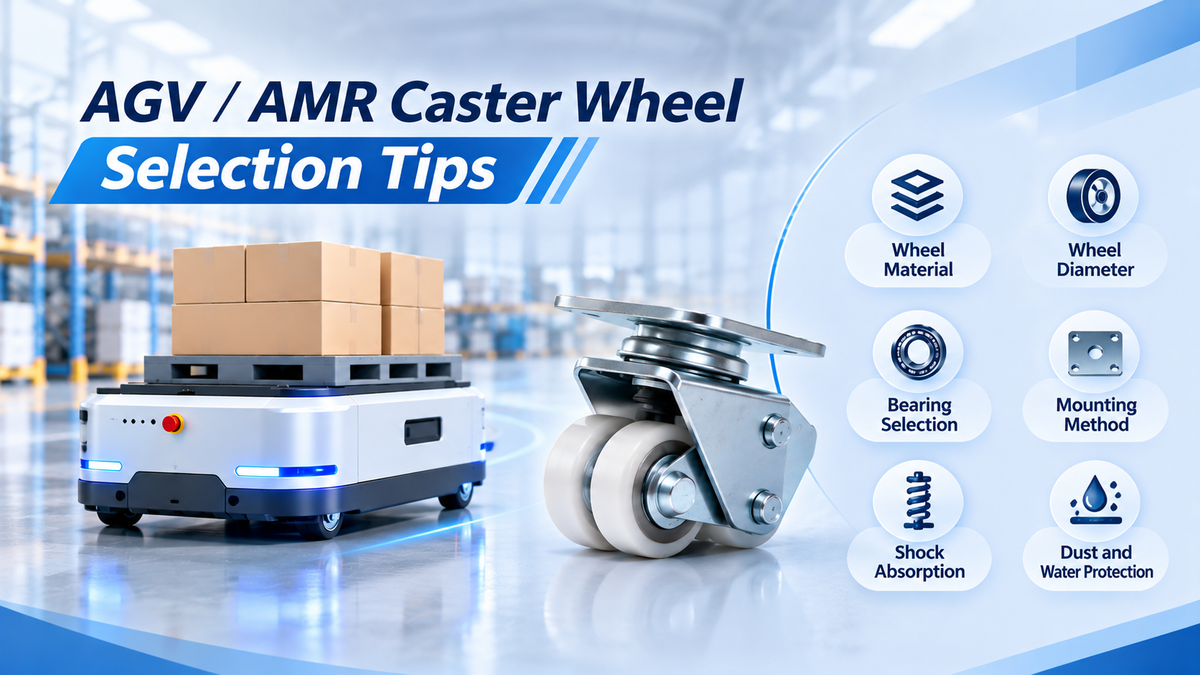
As AGVs (Automated Guided Vehicles) are widely used in smart logistics and industrial automation, the demand for better caster wheel performance and reliability is also increasing.
Unlike AGV drive wheels that provide the power to move the vehicle, AGV caster wheels mainly support the vehicle, assist with movement, and help with steering. A caster wheel may look like a simple mechanical part. However, its material, structure, and performance can all affect how smoothly an AGV runs and how well it performs over time.
In this article, we'll focus on the key factors to consider when choosing them. The goal is to help you find the right caster wheels based on your load requirements, floor conditions, and operating needs.

1. Key Factors When Choosing AGV Caster Wheels
There are many types of AGV caster wheels. Common options include light-duty, medium-duty, and heavy-duty casters, as well as single-wheel, dual-wheel, swivel, and shock-absorbing casters. They differ in load capacity, design, and applications.
But when choosing the right caster, the main factors are usually the same: wheel material, wheel diameter, bearings, mounting method, shock absorption, and dust and water protection.
1.1 Wheel Material: Choose Based on Floor Conditions and Operating Needs
Wheel material is one of the first things to consider when selecting AGV caster wheels.
Different materials offer different levels of wear resistance, flexibility, load capacity, noise, and floor compatibility. These differences directly affect how well an AGV performs over time.
The most common wheel materials for AGV support wheels are polyurethane (PU), nylon, and rubber.
Polyurethane (PU) Caster Wheels
Polyurethane is a common material for AGV caster wheels. It offers good wear resistance, some flexibility, and relatively low operating noise.
For AGVs running on epoxy floors, PVC flooring, or other relatively smooth indoor surfaces, PU caster wheels are often a good first choice.
Nylon Caster Wheels
Nylon is harder and generally has lower rolling resistance. It can be used for industrial equipment that needs relatively high load capacity.
However, because nylon is a hard material, it provides less cushioning. On some smooth or uneven floors, it may also produce more vibration and noise. So it's important to check whether it suits your actual working conditions.
Rubber Caster Wheels
Rubber caster wheels offer good flexibility and cushioning. They can absorb some vibration during operation and help reduce rolling noise.
However, the amount of deformation, rolling resistance, and wear resistance depends on the rubber compound and the actual load. That's why you should choose rubber wheels based on your AGV's operating speed and load requirements.
Selection Tip: For AGVs that run for long periods, don't just look at the wheel material's initial performance. You should also consider wear, changes in wheel diameter, and how the material deforms under continuous load. All these factors can affect caster wheel service life and AGV performance.

1.2 Wheel Diameter: Balance Load Capacity, Mounting Height, and Stability
The diameter of an AGV support wheel should be chosen based on the vehicle's overall design and actual operating conditions.
Generally speaking, when other conditions are similar, larger caster wheels can roll over floor joints and small obstacles more easily. They may also have lower rolling resistance. Smaller wheels, on the other hand, are often better for AGVs with limited mounting space or a low chassis.
But bigger isn't always better.
Larger wheels usually need more installation space and may increase the overall caster height. So the wheel size needs to match the AGV chassis design.
Also, the support wheel diameter doesn't always have to be exactly the same as the drive wheel diameter. What's more important is that the caster's mounting height, load capacity, and operating performance work well with the overall vehicle structure.
Selection Tip: When choosing AGV support wheels, consider chassis ground clearance, available mounting space, floor conditions, operating speed, and actual load. Don't simply choose a larger or smaller wheel without looking at these factors.
1.3 Bearing Selection: Focus on Long-Term Reliability
Bearings are an important part of AGV caster wheel performance.
Unlike ordinary material-handling equipment, many AGVs need to run continuously for long periods. They also experience frequent starts, stops, turns, and load changes. So bearings need to do more than just support the load. They should also provide smooth operation and good durability.
Common deep groove ball bearings can meet the needs of many AGV caster wheels. However, the right bearing still depends on the load, speed, sealing performance, and working environment.
For AGVs that operate for long periods, bearing lubrication, dust protection, and assembly quality are also important.
If a bearing isn't properly sealed, dust and other particles may get inside. This can speed up wear and affect both rolling performance and service life.
Selection Tip: Don't judge an AGV caster wheel only by its rated load capacity. You should also check the bearing configuration, sealing protection, bracket structure, and assembly quality to see whether the caster is suitable for your working conditions.
1.4 Mounting Method: Choose Based on Load and Chassis Design
The mounting structure of an AGV support wheel affects its load performance, ease of installation, and long-term reliability.
Two common wheel axle support designs are cantilever and double-sided support.
Cantilever Design
In a cantilever design, the wheel axle is usually supported from one side. This structure is relatively simple and easy to install, making it suitable for some equipment with limited mounting space.
However, because the axle is supported on only one side, extra attention should be paid to axle strength and bracket rigidity, especially under heavy loads or impact.
Double-Sided Support Design
In a double-sided support design, the wheel axle is supported at both ends. This helps improve how the load is distributed across the axle and makes the design suitable for some applications with higher load requirements.
However, this type of structure usually needs more mounting space and may have a more complex overall design.
Besides the axle support structure, you should also consider the mounting plate dimensions, mounting hole positions, overall caster height, and how the caster connects to the AGV chassis.
Selection Tip: Don't choose a mounting structure based only on the AGV's total weight. You should also consider the actual load on each wheel, load distribution, uneven loading, and impact during operation.
1.5 Shock Absorption: Improve Performance on Uneven Floors
AGVs don't always run on perfectly flat floors.
Even in indoor warehouses or automated production lines, there may be floor joints, small bumps, or uneven areas.
When an AGV passes over these areas, impacts and vibrations can travel through the caster wheels to the vehicle body. This may affect how smoothly the AGV runs.
That's why some AGV support wheels use shock-absorbing structures to reduce impact during operation.
Common shock absorption methods include spring suspension and elastic material cushioning.
Spring Shock Absorption
Spring-based shock absorption uses the compression and rebound of springs to handle a certain amount of floor unevenness. It is suitable for AGVs that need some suspension travel.
The actual performance also depends on spring stiffness, preload, suspension travel, and damping design.
Elastic Material Shock Absorption
Shock-absorbing structures made with elastic materials such as polyurethane are usually more compact. They use the material's natural flexibility to reduce some vibration and impact.
This type of design is suitable for applications with limited mounting space and relatively smooth floors.
Selection Tip: If your AGV needs to cross floor joints, small changes in slope, or uneven areas, shock-absorbing casters may be worth considering. But softer isn't always better. You also need to consider vehicle stability, load capacity, and whether the drive wheels maintain proper contact with the floor.
1.6 Dust and Water Protection: Choose Based on the Working Environment
AGVs operate in many different environments.
Some run in clean workshops. Others work for long periods in regular warehouses, dusty production areas, or relatively humid environments.
Different environments have different requirements for bearing seals, bracket materials, and surface protection.
In dusty environments, bearing sealing and dust protection are especially important. They help prevent particles from entering the bearings and causing wear.
In humid environments, you should pay attention to the corrosion resistance of brackets, fasteners, and bearings.
For special environments such as clean workshops, you may also need to consider material cleanliness, lubricant use, and particle contamination control.
Selection Tip: Choose the right protection design based on your AGV's actual working environment. If your application has specific requirements for water resistance, dust protection, or cleanliness, ask the supplier to confirm the relevant product specifications and test results.

2. How to Choose Between Different Types of AGV Caster Wheels
Besides wheel material, diameter, and bearings, the caster's structural design should also match the actual application.
Here are some common types of AGV caster wheels and their typical applications.
| Caster Type | Key Features | Typical Applications |
| Light-Duty Rubber Casters | Good elasticity and relatively quiet operation | Light-duty AGVs and indoor auxiliary support |
| Medium-Duty High-Speed Support Wheels | Balance rolling performance with operational stability | AGVs with higher operating-speed requirements |
| Heavy-Duty Single-Wheel Casters | Relatively compact design; load capacity depends on the specific configuration | Industrial material-handling AGVs and heavy-load support |
| Heavy-Duty Dual-Wheel Casters | Dual-wheel design supports heavy loads while allowing maneuverability | Heavy-duty AGVs and logistics handling equipment |
| Heavy-Duty Polyurethane (PU) Casters | Good wear resistance; suitable for certain continuous-duty applications | Warehousing, logistics, and automated production lines |
| Shock-Absorbing Casters | Integrated suspension helps reduce impacts during operation | Floors with joints or minor unevenness |
It's important to remember that different types of caster wheels can vary greatly in load capacity, operating speed, and mounting dimensions.
3. Partner with HKT ROBOT for AGV Caster Wheels and Motion Solution
AGV caster wheels usually account for only a small part of the total vehicle cost. However, they can have a significant impact on operating stability, reliability, and long-term maintenance costs.
With over 10 years of solid experience in the AGV industry, HKT ROBOT understands the real working conditions that AGV caster wheels face. These include frequent starts and stops, continuous operation, heavy loads, and steering and movement on different floor surfaces.
We believe a good AGV caster wheel should do more than simply fit and turn. It should also run smoothly over time, resist wear, and work well with the overall AGV design.
3.1 A Wide Range of AGV Caster Wheels for Different Applications
To meet different AGV load requirements, operating speeds, and working environments, HKT ROBOT offers caster wheels of various diameters, load capacities, and types, such as heavy-duty AGV casters and swivel casters.
At HKT ROBOT, we pay close attention to durability and consistent quality in mass production. Our AGV caster wheels go through various tests, including service life, impact resistance, and wear resistance testing, to check their reliability.
Our caster wheels are designed for low-noise operation, wear resistance, and long-term durability. They can meet the performance needs of different industrial applications.
We also support custom mounting plate dimensions for different AGV chassis designs to achieve a better fit and reduce installation and compatibility issues.
3.2 More Than AGV Caster Wheels: We Understand the Complete AGV Motion System
We provide not only AGV caster wheels but also AGV drive wheels, servo motors, gearboxes, and other key agv components.
This means we don't just focus on the caster wheel itself, such as its load capacity, wheel material, and service life. We also pay attention to how the caster works as part of the complete AGV motion system.
With our experience in AGV motion and drive system products, HKT ROBOT can better understand customers' needs from a wider perspective. We help customers choose AGV caster wheels that better match their equipment design and working conditions.
Whether you're developing a new AGV or looking for a reliable caster wheel supplier for an existing project, HKT ROBOT offers a range of AGV caster wheels and related product support.
If you need help with AGV caster wheel selection or other agv components, feel free to contact us.
Paylaşmak:
Integrated vs. Split AGV Servo Motors: Which One Fits Your AGV/AMR Project?