7*24 Saat Destek ve Tam Sürücü Sistemi Çözümleri

Here's the thing: the servo motor in an AGV or AMR affects more than just performance. It also affects how the vehicle is laid out, how easy it is to maintain, and whether you can upgrade it later.
Many engineers get stuck between two options: integrated servo motors look compact and easy to install, while split servo motors offer more flexibility and are easier to adapt to different vehicle designs.
Honestly, neither option is automatically better. The real question is: what kind of load, speed, and installation space does your AGV need, and how often will it need maintenance or upgrades? Once you answer that, the choice becomes much clearer.

What Is an Integrated AGV Servo Motor?

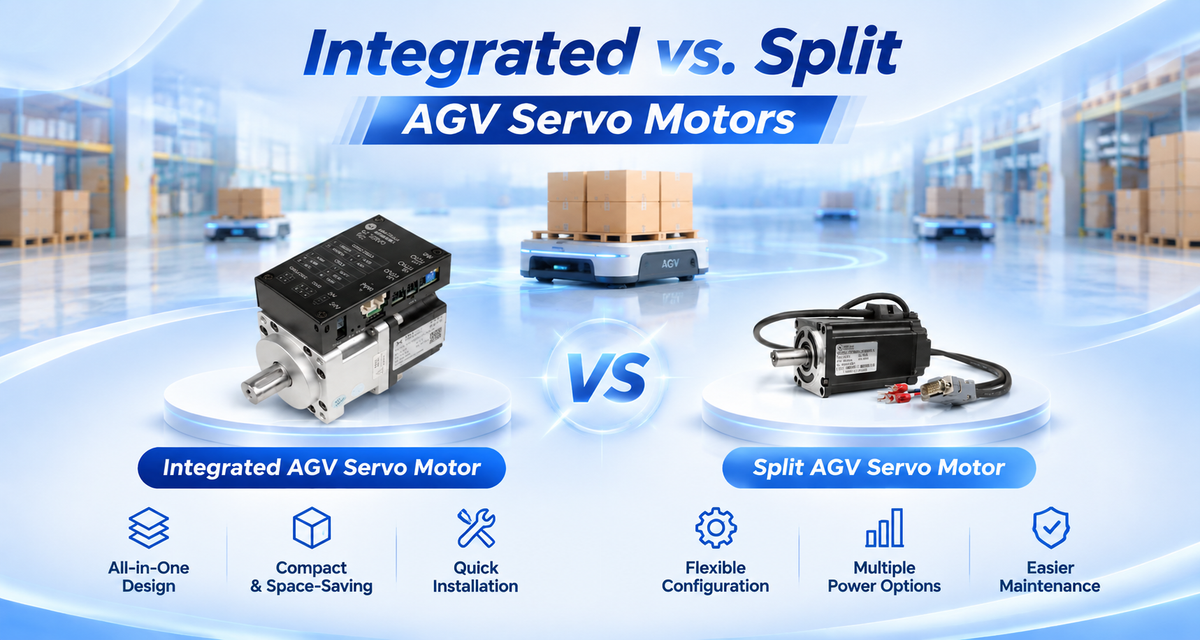
An integrated servo motor, sometimes called an integrated servo drive, combines the servo motor, encoder, and driver into one compact unit. In some designs, part of the transmission structure is built in as well.
For AGVs, the biggest advantage is space saving. Since the motor, driver, and feedback components are placed close together, you need fewer cables and fewer connectors. This makes the layout cleaner and easier to manage, especially in small AGVs, narrow-aisle robots, or steering systems where space is tight.
It also works well for highly standardized products. If an AGV already has a fixed load capacity, wheel size, gear ratio, and communication protocol, using an integrated module in mass production can reduce assembly and commissioning work.
But let’s be honest: integrated servo motors are not a “one-size-fits-all” solution. Because more functions are packed into one module, replacing a single part is often less flexible than with a split system.

What Is a Split AGV Servo Motor?

A split servo motor, also called a split servo system, takes a different approach. Instead of putting everything into one module, the motor, driver, gearbox, encoder, and drive wheel are arranged separately based on function.
In a typical AGV drive system, the controller sends commands to the servo drive, which controls the servo motor. The motor drives the gearbox, and the gearbox turns the drive wheel to move the vehicle.
The controller handles path planning, speed, and steering logic. The servo drive receives commands and adjusts the motor’s current, speed, torque, and position. The motor provides power, the gearbox converts high speed into the low speed and high torque needed at the wheel, and the drive wheel transfers that force to the ground.
This setup may look more complex, but it gives you much more flexibility. You can choose the motor power, gear ratio, wheel diameter, brake, encoder type, and even wheel material separately, instead of replacing the whole drive unit just to change one part.

Advantages of Integrated AGV Servo Motors

The biggest advantage of an integrated servo motor is simple: high integration, easy installation, and space savings.
For AGVs with limited internal space, especially small mobile robots or steering wheel systems, combining the motor, driver, and encoder into one unit reduces cable length and connector count. It also makes the mechanical layout cleaner. In the reference case, an AGV steering wheel uses an integrated servo motor with a gearbox, driving the steering wheel directly through a synchronous belt to achieve precise steering in a tight space.
It also suits projects where the design is unlikely to change much. When the motor, driver, and control logic are already matched by the manufacturer, system commissioning becomes more straightforward and on-site integration work is reduced.
But here is the thing: integrated solutions work best when the structure is fixed and the operating conditions are stable. If you expect to change the load, wheel size, or gear ratio later, that flexibility is limited.

Advantages of Split AGV Servo Motors

The value of a split servo motor comes down to three things: maintainability, customization, and system flexibility.

Easier Maintenance and Replacement

AGVs run for a long time. Drive wheels wear out, gearboxes may need service, and motors may need upgrades as operating conditions change. With a split setup, you can inspect, replace, or upgrade the motor, gearbox, and drive wheel separately, without removing the entire drive module.
This matters a lot in warehouses, factories, and logistics centers that run around the clock. Less downtime means less impact on production.

Easier to Match Different Vehicle Types

AGVs come in many shapes and sizes. Some carry a few hundred kilograms, others handle 1.5 to 3 tons. Some focus on speed, while others need strong climbing ability and frequent start-stop cycles. A split system lets engineers fine-tune motor power, gear ratio, wheel diameter, communication protocol, and encoder type to match the real application.
For example, heavy-duty AGVs often need higher wheel-end torque and a more suitable gear ratio. You cannot just bolt on a standard integrated module and expect it to work. A split structure lets you match the motor and gearbox to the load, slope, wheel size, and speed, instead of being locked into a fixed module.

Better Heat Dissipation and Reliability

Servo drives generate heat during operation. In an integrated design, the drive electronics are usually close to the motor body. In a split design, the driver can be mounted on the chassis or another location that is easier to cool and service. For AGVs that run continuously, operate in high temperatures, or face dust and moisture, this layout is often more reliable.
Of course, a split system needs more cables and connectors, so installation and wiring protection matter. But if designed well, the maintainability and flexibility you gain usually outweigh the extra work.

How to Choose Between the Two Kinds of AGV Servo Motors?

Factor Integrated Servo Motor Split Servo Motor
Installation space More compact, good for tight layouts Takes up more space
Wiring Fewer cables, higher integration More cables and connectors
Selection flexibility Lower, module configuration is fixed High, motor, gearbox, and wheel can be chosen separately
Maintenance Often requires replacing the whole module or a large part Motor, gearbox, and wheel can be replaced separately
Best for Small AGVs, standardized models, tight spaces Heavy-duty AGVs, custom vehicles, long-term maintenance
Future upgrades Higher cost to modify Easier to upgrade power, gear ratio, or wheel size
If you are building a small AMR with very limited space, or a product that is already highly standardized, an integrated servo motor makes sense. But if you are working on a forklift-style AGV, heavy-duty mobile robot, or a vehicle that needs strong load capacity, climbing ability, and long-term maintenance, split servo motor is usually the safer choice.

AGV Drive Systems Are More Than Just Motors

Many people focus only on motor power when choosing a drive system. But an AGV is a system. Even a strong motor will not help if the gear ratio is wrong, the drive wheel slips, or the controller communication does not match.
When choosing a split servo motor, make sure you check these things: total vehicle weight, maximum speed, climbing requirement, drive wheel diameter, required wheel-end torque, gear ratio, encoder type, and whether the controller supports CANopen, RS485, or another communication protocol.
The encoder matters too. AGV drive wheel motors usually use closed-loop control, where the controller keeps adjusting speed and position based on encoder feedback. Incremental encoders cost less and work well for basic speed control and distance measurement. Absolute encoders keep position data after power loss, which reduces the time needed to re-home and suits applications with frequent power cuts, emergency stops, or unmanned operation.

Partner with HKT ROBOT for AGV Servo Motors and Drive Solutions

Choosing a servo motor is not just about picking the highest power rating. Whether an AGV runs smoothly, climbs well, and stops accurately depends on how well the motor, gearbox, drive wheel, and controller work together.
Founded in 2013, HKT ROBOT has over 10 years of experience in manufacturing and delivering core components for AGV/AMR motion and control. Our product range covers AGV servo motors, servo drives, AGV gearboxes, steering drive wheels, differential drive units, and lifting mechanisms.
Our AGV servo motors come with incremental or absolute encoders, optional brakes, and customized speed options. They are designed for low noise, precise control, and a service life of up to 20,000 hours. Plus, we offer a 2-year warranty for your peace of mind. 
But we don’t just supply motors—we provide a complete drive solution.
Based on the vehicle’s total mass, maximum payload, target speed, climbing requirement, number of drive wheels, and available installation space, we help select the right motor power, gear ratio, encoder type, communication protocol, and drive configuration.
We also support customization based on project needs. If you are developing a new AGV or AMR, you can share the vehicle weight, target speed, climbing angle, drive wheel size, and installation space with us. Our sales and engineering team can help evaluate the right servo motor and motion control solution for you.

Frequently Asked Questions for AGV Servo Motors

1. Are integrated servo motors suitable for heavy-duty AGVs?

Not always. Heavy-duty AGVs need strong wheel-end torque, good climbing ability, and stable performance over long periods. If the integrated module’s power, gear ratio, or heat dissipation does not match, it can limit the whole vehicle. In that case, a split system is usually easier to match to the actual conditions.

2. Are split servo motors harder to install?

Compared with integrated units, yes, they need more wiring and assembly work. But if you plan the mounting position, cable routing, and protection properly, on-site commissioning is not much harder. The benefit is easier maintenance and replacement later.

3. Should I choose an incremental or absolute encoder for AGV motors? 

If the vehicle often loses power, stops suddenly, or needs to recover position quickly, an absolute encoder is better. If you only need basic speed control and distance measurement, an incremental encoder is cheaper and usually enough.

4. Which option costs less, integrated or split AGV Motors?

Integrated systems usually cost less upfront because they are more modular and easier to assemble. But repairs or upgrades later can cost more. Split systems need more wiring and assembly at the start, but maintenance costs are usually lower over time.