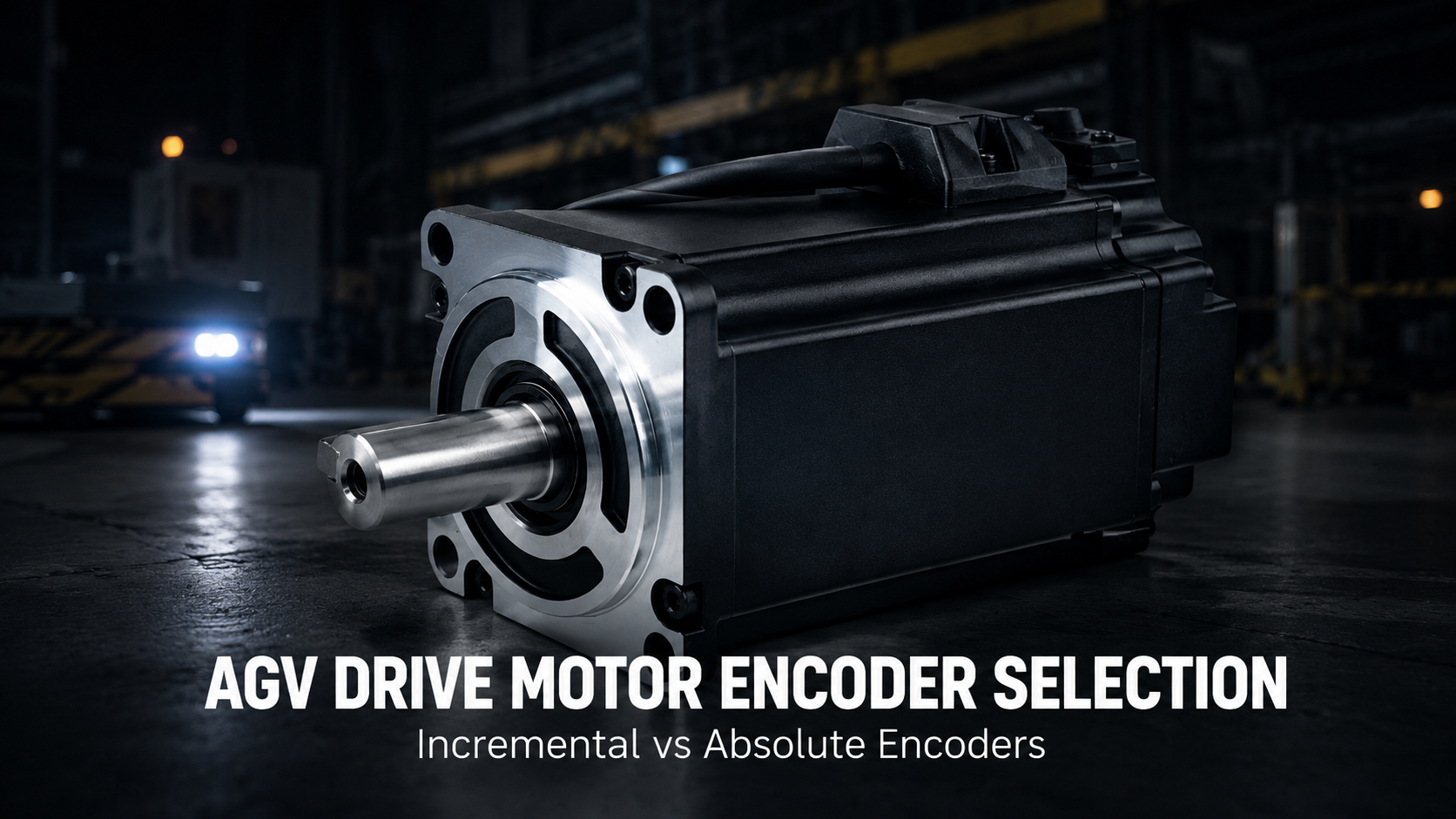
Encoder selection is one of the most overlooked decisions in AGV drive wheel design, yet it directly determines how accurately an automated guided vehicle tracks its position, holds speed, and recovers from a power cycle. Much of that decision comes down to where the encoder lives and how it is protected — a detail that varies meaningfully between suppliers. This guide focuses specifically on encoder selection for AGV drive wheels, the traction motors responsible for moving the vehicle forward and backward, and walks through how incremental and absolute encoders differ, where each performs best, and how to match encoder type to your drive system requirements.

What Is an Encoder in an AGV Drive System?
An encoder is a feedback device that converts rotational motion into an electrical signal a motor controller can read. In an AGV drive wheel motor, the encoder is what allows the drive system to know not just that the motor is turning, but how fast, in which direction, and — depending on encoder type — exactly where the shaft is positioned at any given moment.
Role of Encoders in Closed-Loop Motor Control
AGV drive motors almost always run in closed-loop control, meaning the motor controller continuously compares the commanded speed or position against the actual value reported by the encoder, then adjusts current to correct any error. Without accurate encoder feedback, this loop breaks down: the vehicle may drift off its intended speed, overshoot stopping points, or fail to detect wheel slip on a slick or debris-covered floor.
Where Encoders Are Installed on AGV Drive Wheels
On HKT drive wheel motors, the encoder is mounted internally, integrated directly into the motor housing rather than added as a separate external component. This integrated mounting keeps the encoder sealed away from dust, moisture, and mechanical shock that the drive wheel is exposed to at floor level, which supports a higher protection rating without adding a separate housing. It also removes alignment as a field variable — the encoder is calibrated to the motor shaft at the factory, so installers are not responsible for setting shaft tolerances or centering an external disc during assembly. The result is a more compact motor unit with fewer external connectors and shorter signal paths, which also reduces the risk of noise interference on the encoder line.
Incremental Encoders Explained
Incremental encoders are the more common and generally more affordable choice for AGV drive wheel motors, particularly in cost-sensitive or high-volume deployments.
How Incremental Encoders Work
An incremental encoder generates a series of electrical pulses as the motor shaft rotates, typically through two channels offset by 90 degrees (commonly labeled A and B) to determine direction, plus an optional Z channel that fires once per revolution as a reference index. The controller counts these pulses relative to a starting point to calculate speed and relative position. Resolution is usually expressed in pulses per revolution, or PPR — common values for AGV drive wheel motors range from a few hundred to several thousand PPR, with quadrature decoding effectively multiplying that count by four.
Advantages and Limitations for AGV Drive Wheels
Incremental encoders are inexpensive, mechanically simple, and well suited for speed control and basic odometry. Their main limitation is that they have no memory of absolute position: when power is cut, the count resets, and the controller loses track of exactly where the motor shaft is. On a drive wheel used for propulsion, this is less critical than on a steering axis, since the AGV's navigation system typically re-establishes position using external references (QR codes, reflectors, or SLAM landmarks) once it resumes motion. Still, incremental encoders alone cannot support applications where the drive motor's exact rotational position must be known immediately at power-up.
Absolute Encoders Explained
Absolute encoders solve the power-loss problem inherent to incremental designs by assigning a unique digital value to every possible shaft position.
How Absolute Encoders Work
Rather than counting pulses from a reference point, an absolute encoder reads a fixed pattern — optical or magnetic — that corresponds to a specific angular position. Each position produces a distinct digital output, so the controller always knows the exact shaft angle immediately after power-up, without needing to move the motor first to re-home the system.
Single-Turn vs Multi-Turn Absolute Encoders
Single-turn absolute encoders report position within a single 360-degree rotation and reset each revolution. Multi-turn absolute encoders add a turns counter — often maintained through a small battery or a gear-based mechanical counter — so the system also knows how many full rotations the shaft has completed, not just its position within the current turn. For AGV drive motors, which rotate continuously and in both directions during normal operation, multi-turn tracking is generally more useful than it is on a steering axis with limited rotational range.
Advantages and Limitations for AGV Drive Wheels
The clear benefit of an absolute encoder on a drive motor is instant position awareness after any power interruption, which shortens recovery time and reduces the need for a full re-homing sequence. The tradeoff is cost: absolute encoders, particularly multi-turn versions with higher bit resolution, cost more than incremental units and typically require a more complex communication interface such as SSI, BiSS-C, or CANopen rather than simple pulse output. Since the encoder sits inside the motor housing on HKT drive wheel motors, upgrading from incremental to absolute is handled as a factory configuration option rather than a field modification, which keeps the external motor and gearbox interface unchanged.

Key Differences Between Incremental and Absolute Encoders
The table below summarizes the core distinctions relevant to AGV drive wheel encoder selection.
| Feature | Incremental Encoder | Absolute Encoder |
|---|---|---|
| Position after power loss | Lost — requires re-homing | Retained — known immediately |
| Output signal | Pulse train (A/B/Z channels) | Unique digital code per position |
| Typical interface | Quadrature / open collector | SSI, BiSS-C, CANopen, or similar |
| Relative cost | Lower | Higher |
| Best suited for | Speed control, basic odometry | Precision position tracking, fast power-up recovery |
| Mechanical complexity | Simple | Moderate to higher (especially multi-turn) |
Resolution and Accuracy
Resolution determines how finely the encoder can distinguish between positions or speed changes. Incremental encoders are described in PPR, while absolute encoders are described in bits — a 12-bit single-turn encoder, for example, resolves 4,096 distinct positions per revolution. Higher resolution improves odometry accuracy but also increases data throughput requirements on the control bus, which matters when multiple drive motor encoders report simultaneously.
Power-Loss Behavior and Homing
This is the single largest practical difference between the two types. An AGV that loses power mid-cycle with an incremental encoder needs a homing routine — either a physical reference switch or a controlled movement — before position tracking is reliable again. An absolute encoder skips this step entirely, which can meaningfully reduce downtime in facilities with frequent power cycling or emergency stops.
Signal Output and Communication Protocols
Incremental encoders typically use simple digital pulse outputs that are easy to wire and decode with standard motor controllers. Absolute encoders more often use serial protocols that pack position, and sometimes diagnostic data, into a single communication line, which reduces wiring complexity but requires a controller capable of decoding the specific protocol in use.
Cost and System Complexity
Beyond the encoder unit price itself, absolute encoders can add cost through required controller compatibility, connector types, and in the case of battery-backed multi-turn units, ongoing battery maintenance. For high-volume AGV fleets, this cost difference compounds quickly, which is why many drive wheel applications default to incremental encoders unless a specific functional requirement calls for absolute feedback.
How to Select the Right Encoder for Your AGV Drive Wheel Motor
Encoder selection should follow from the AGV's navigation architecture, safety requirements, and operating environment rather than being chosen in isolation.
Matching Encoder Type to Navigation and Control Requirements
If the AGV's navigation system (SLAM, magnetic tape, QR code grid, or reflector-based laser navigation) can quickly re-establish absolute position after a stop, an incremental encoder on the drive motor is usually sufficient, since the encoder's role is limited to speed feedback and short-term odometry between navigation fixes. If the application requires immediate position confidence at power-up — for example, in a lights-out facility where AGVs restart unattended after a scheduled shutdown — an absolute encoder reduces recovery time. For a deeper look at how encoder choice fits into the broader motor and controller stack, see this overview of AGV drive system components and types.
Environmental and Protection Class Considerations
Drive wheel motors operate close to the floor and are exposed to dust, moisture, and occasional impact. Because HKT encoders are integrated inside the sealed motor housing rather than mounted externally, the encoder benefits from the same IP-rated protection as the motor itself, rather than requiring a separate seal or cover. Magnetic encoder technology also tends to tolerate contamination better than optical designs, which can be affected by dust accumulating on the code disc.
Encoder Resolution and Odometry Accuracy
For AGVs relying partly on dead-reckoning between navigation landmarks, higher encoder resolution directly improves odometry accuracy. As a general guideline, applications with longer distances between navigation fixes, or tighter path-following tolerances, benefit from higher PPR incremental encoders or higher-bit absolute encoders, while short-distance, frequently-corrected navigation can tolerate lower resolution without a meaningful accuracy penalty.
Common Encoder Problems in AGV Drive Systems and How to Avoid Them
Encoder-related faults are among the more frequent causes of unexpected AGV drive system downtime, and most are preventable with correct selection and installation.
Signal Noise and Interference
Long cable runs near motor power lines can introduce electrical noise into encoder signal wiring, causing miscounted pulses on incremental encoders or intermittent errors on serial absolute interfaces. Shielded cabling, proper grounding, and physical separation from power cables reduce this risk significantly.
Mechanical Misalignment
On motors where the encoder is mounted externally, off-axis installation or excessive shaft play can generate inconsistent signals that degrade over time rather than failing outright, which makes the root cause harder to diagnose in the field. Because the encoder is factory-integrated into the motor shaft on HKT drive wheel motors, this class of fault is largely eliminated before the unit ever reaches installation. General drive system fault patterns are covered in more detail in this guide to common AGV servo drive problems.
Power-Loss Position Drift
On incremental-encoder drive motors, any unplanned power interruption during motion introduces a position gap that the navigation system must reconcile on restart. Facilities with unstable power or frequent emergency stops should weigh this against the added cost of an absolute encoder, since repeated re-homing cycles can measurably affect fleet throughput.
FAQ
Do AGV drive wheels always need an encoder?
Nearly all AGV drive wheel motors use some form of encoder feedback, since closed-loop speed control and accurate odometry both depend on it. Open-loop drive systems without encoders exist but are uncommon in commercial AGV applications due to reduced precision and safety monitoring capability.
Can an incremental encoder be upgraded to absolute later?
On motors with an internally integrated encoder, switching from incremental to absolute is generally handled as a factory configuration selected at the time of order, since the encoder is built into the sealed motor housing rather than added as a separate external part. Confirming encoder type before ordering avoids the need to source a different motor variant later.
What resolution encoder is typical for AGV drive wheels?
Resolution requirements vary by application, but many AGV drive wheel motors use incremental encoders in the range of 500 to 2,500 PPR, or absolute encoders with 12 to 17-bit single-turn resolution, depending on required odometry accuracy and navigation architecture.
Do incremental and absolute encoders use the same wiring?
No. Incremental encoders typically use simple pulse-output wiring (A/B/Z channels), while absolute encoders generally require a serial communication interface such as SSI, BiSS-C, or CANopen, which is not interchangeable with incremental wiring without a different controller input.
How does encoder choice affect AGV safety systems?
Loss of encoder signal is typically treated as a fault condition that triggers a controlled stop, since the drive controller can no longer verify speed or position. Some safety-rated AGV designs use redundant encoders or cross-check drive motor encoder data against independent sensors to meet functional safety requirements.
Conclusion
Encoder selection for AGV drive wheels comes down to a straightforward tradeoff: incremental encoders offer a lower-cost, mechanically simple solution well suited to speed control and standard odometry, while absolute encoders add cost and complexity in exchange for immediate position awareness after any power interruption. Neither option is universally correct — the right choice depends on your AGV's navigation architecture, how often the system experiences power cycling, and how much recovery downtime your operation can tolerate. Motors with an internally integrated encoder also remove field alignment and sealing as variables, which simplifies the decision to largely a question of incremental versus absolute. Working through resolution, protection class, and signal interface requirements early in the drive system design process avoids costly rework later, and a supplier familiar with both encoder types can help match the right configuration to your specific drive motor and application.

Paylaşmak:
AGV Drive Wheel with Gearbox: Structure, Key Specs, and Sourcing Guide