

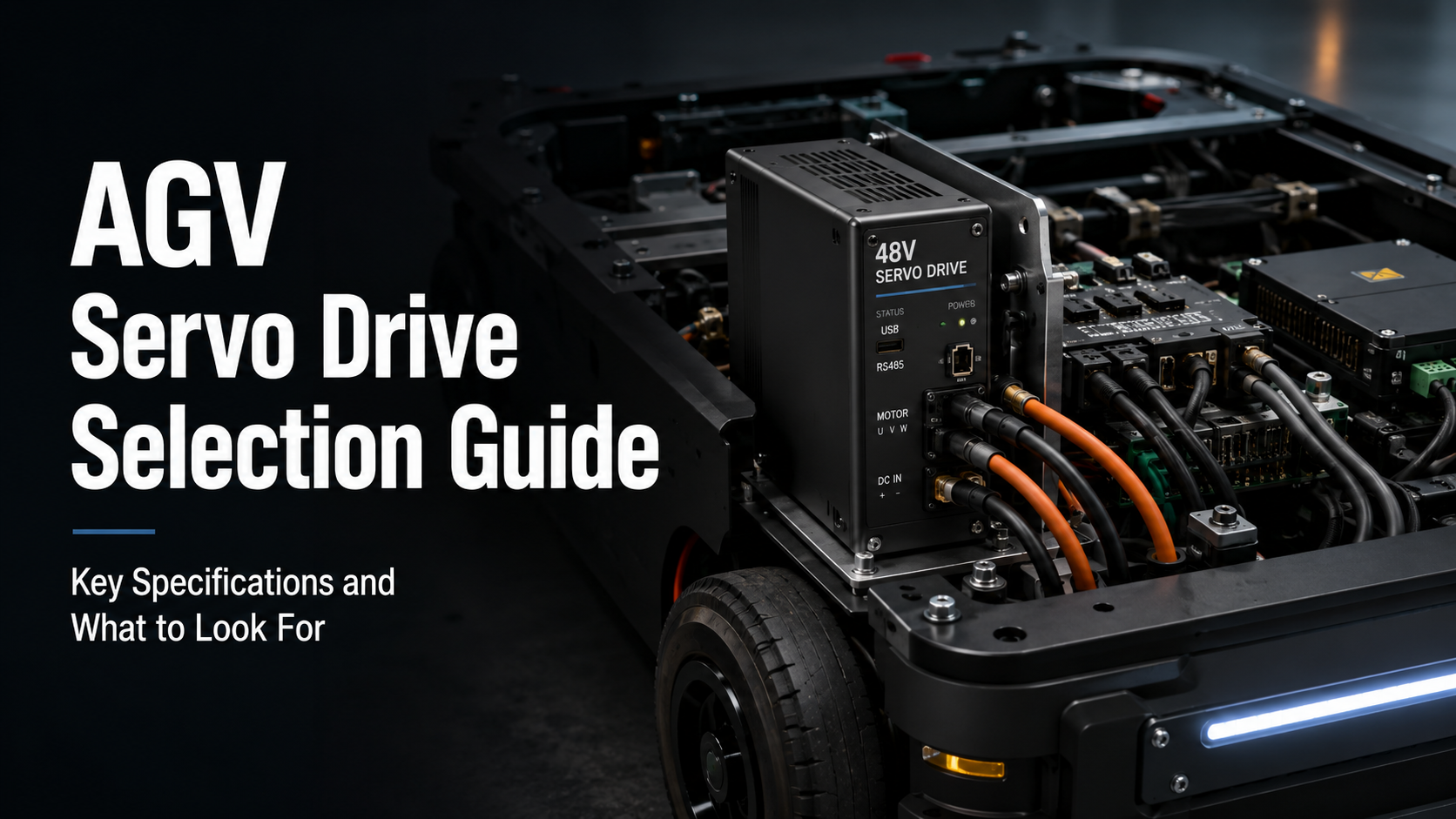
Cada motor AGV necesita un servocontrolador. El motor convierte la energía eléctrica en par mecánico, pero sin un servocontrolador que regule esa conversión con precisión, el motor es solo una masa giratoria sin control. El servocontrolador es lo que hace que un motor responda: lee la retroalimentación del codificador, la compara con la posición o velocidad ordenada y ajusta la corriente de salida en tiempo real para cerrar el bucle de control.
En las aplicaciones de AGV y AMR para almacenes, el servocontrolador funciona continuamente en ciclos de trabajo exigentes: arranques y paradas frecuentes, cambios de dirección, variaciones de carga a medida que se recogen o dejan estantes, e intercambios de comunicación con los controladores del vehículo decenas de veces por segundo. Un servocontrolador correctamente especificado para estas condiciones funciona de forma fiable durante años con una atención mínima. Uno que esté subdimensionado, marginalmente térmico o incompatible con el motor o el controlador se convierte en una fuente de fallos difíciles de diagnosticar y costosos de rectificar en una flota desplegada.
Esta guía de selección de servocontroladores AGV cubre los fundamentos de lo que hacen los servocontroladores en los sistemas AGV, por qué las configuraciones de baja tensión de 48 V se han convertido en el estándar dominante, las especificaciones que más importan durante la selección y los criterios de integración y proveedor que determinan si un servocontrolador funciona como se espera en producción.

¿Qué es un servocontrolador AGV y qué hace?
Un servocontrolador, también llamado servoamplificador o controlador de motor, es una unidad de electrónica de potencia que se encuentra entre el controlador principal del vehículo y el motor de tracción o dirección. Recibe comandos de movimiento del controlador, mide el comportamiento real del motor a través de la retroalimentación del codificador y emite corriente trifásica regulada para impulsar el motor hacia el estado ordenado.
En un sistema de servo de bucle cerrado, este proceso ocurre continuamente. El controlador compara la velocidad o posición ordenada con los valores reales medidos por el codificador, calcula el error y aplica una salida de corriente correctiva a través de un PID o un algoritmo de control más avanzado. El resultado es un motor que sigue los comandos con precisión incluso cuando cambian las condiciones de carga, algo fundamental en las aplicaciones AGV donde el peso de la carga útil, la pendiente del suelo y las fuerzas en las curvas afectan la demanda de par en la rueda motriz.
Más allá del control de movimiento básico, un servocontrolador para aplicaciones AGV típicamente maneja el frenado regenerativo, recuperando energía cinética durante la desaceleración y devolviéndola a la batería o al bus del vehículo, monitorea la temperatura del motor, los límites de corriente y la integridad de la señal del codificador, y comunica datos de estado y fallos al controlador del vehículo a través de un bus digital.
Por qué los servocontroladores de baja tensión de 48 V dominan las aplicaciones AGV
Los servocontroladores industriales están disponibles en un amplio rango de tensión, desde sistemas de 24 V hasta servoamplificadores industriales de 600 V. Para las aplicaciones AGV y AMR de almacén, los 48 V de CC han surgido como la tensión de bus dominante, y comprender por qué aclara varios criterios de selección importantes.
Compatibilidad de la batería. La mayoría de las plataformas AGV de almacén utilizan baterías de fosfato de hierro y litio (LFP) o de iones de litio en el rango nominal de 48 V. Un servocontrolador de 48 V se conecta directamente al bus del vehículo sin una conversión de CC-CC intermedia, eliminando una etapa de conversión, sus pérdidas asociadas y un posible punto de fallo.
Umbral de seguridad. Los 48 V CC están por debajo del umbral de 60 V CC definido como tensión peligrosa en la mayoría de las normas internacionales de seguridad eléctrica. Esto simplifica el diseño de la seguridad eléctrica del vehículo, reduce los requisitos de aislamiento y permite al personal de servicio trabajar en el sistema eléctrico con precauciones estándar en lugar de protocolos de seguridad de alta tensión.
Compatibilidad del motor. El servocontrolador de 48 V se combina directamente con servomotores de CC de 48 V, que están diseñados específicamente para aplicaciones de transmisión AGV y están disponibles en rangos de potencia desde varios cientos de vatios hasta 2000 W y más, cubriendo todo el espectro de clases de carga útil de robots de almacén.
Eficiencia del sistema. Los servocontroladores de baja tensión con etapas de salida modernas de SiC o MOSFET logran eficiencias de conmutación superiores al 95 %, minimizando la generación de calor y extendiendo la duración de la batería, ambos parámetros críticos en los sistemas AGV donde la capacidad de la batería afecta directamente el tiempo de actividad operativa entre cargas.

Especificaciones clave para la selección de servocontroladores AGV
Tensión nominal y rango de entrada
La tensión de entrada nominal del servocontrolador debe coincidir con la tensión del bus de la batería del vehículo. Para sistemas AGV de 48 V, busque servocontroladores con una entrada nominal de 48 V CC y un rango de funcionamiento que se ajuste al rango completo de tensión de carga y descarga de la batería, normalmente de 40 V a 58,8 V para una batería LFP estándar. Los servocontroladores con una clasificación exacta de 48 V nominales sin margen en el extremo superior activarán la protección contra sobretensión durante los eventos de frenado regenerativo cuando la tensión del bus supere el valor nominal.
Corriente de salida continua y pico
La clasificación de corriente continua define cuánta corriente de salida puede mantener el controlador indefinidamente sin daños térmicos. La clasificación de corriente pico es la salida máxima que el controlador puede entregar durante períodos cortos (típicamente de 1 a 3 segundos) para cubrir los eventos de arranque del motor, aceleración y respuesta a obstáculos.
Seleccione un controlador cuya clasificación de corriente continua cubra cómodamente la corriente nominal del motor con carga máxima. La clasificación de corriente pico debe cumplir con la corriente de calado del motor o la demanda máxima de corriente instantánea. Operar un controlador continuamente cerca de su límite térmico degrada la vida útil de los componentes y aumenta la frecuencia de fallas en condiciones reales.
Modos de control
Los servocontroladores AGV están disponibles con diferentes capacidades de modo de control. Los tres modos principales son el control de posición, el control de velocidad y el control de par. La mayoría de las aplicaciones de tracción AGV funcionan principalmente en modo de control de velocidad, con el control de posición utilizado para maniobras precisas de parada y alineación. El control de par se utiliza en aplicaciones específicas, como el reparto de carga entre varias ruedas motrices.
Verifique que el servocontrolador admita todos los modos de control requeridos por el controlador de movimiento del vehículo y que el cambio de modo se pueda comandar a través de la interfaz de comunicación sin necesidad de reiniciar el servocontrolador. Algunos servocontroladores de menor especificación requieren cambios de configuración física o la actualización del firmware para cambiar los modos de control, lo cual es impracticable en una flota desplegada.
Interfaz de comunicación
La interfaz de comunicación entre el servocontrolador y el controlador del vehículo del AGV es uno de los parámetros de compatibilidad más críticos y uno de los que con más frecuencia se pasa por alto durante la especificación inicial. Las interfaces comunes en las aplicaciones AGV incluyen bus CAN, CANopen, EtherCAT, RS485/Modbus y entradas digitales de pulso-dirección.
La interfaz de comunicación del controlador debe coincidir exactamente con la interfaz de salida del controlador, tanto la capa física como el protocolo. Un controlador con una capa física CAN que ejecuta un protocolo propietario no se comunicará con un controlador que espera CANopen, aunque el conector de hardware sea idéntico. Confirme la compatibilidad del protocolo con la documentación real del controlador, no asumida solo por el tipo de interfaz.
Compatibilidad con codificadores
El servocontrolador lee la posición y la velocidad del motor a partir de un codificador montado en el eje del motor. Los tipos de codificador incluyen codificadores incrementales, codificadores absolutos y sistemas basados en resolutor. La entrada del codificador del servocontrolador debe ser compatible con el tipo de codificador del motor tanto en formato de señal como en resolución.
Para las aplicaciones AGV, la resolución del codificador afecta tanto la suavidad del control de velocidad a bajas velocidades (importante durante las maniobras de acoplamiento precisas) como la precisión de los datos de odometría enviados al sistema de navegación. Una mayor resolución del codificador generalmente mejora la calidad del control a baja velocidad, pero el servocontrolador debe ser capaz de procesar el mayor número de pulsos sin perder conteos a la velocidad máxima.
Características de protección
Un servocontrolador que funcione en un entorno AGV de almacén debe incluir protección de hardware contra sobrecorriente, sobretensión, subtensión, sobretemperatura, pérdida de señal del codificador y tiempo de espera de comunicación. Estas protecciones deben activarse de forma fiable y registrar códigos de fallo accesibles para el controlador del vehículo para el diagnóstico. Los servocontroladores que se apagan sin registrar fallos dificultan considerablemente la resolución de problemas en el campo.
La respuesta de parada de emergencia —el comportamiento del servocontrolador cuando se recibe una señal de parada de emergencia— debe ser configurable entre la desactivación inmediata del par y la desaceleración controlada, dependiendo del diseño del sistema de seguridad del vehículo y de las normas de seguridad aplicables.
Temperatura de funcionamiento y gestión térmica
Los servocontroladores generan calor en proporción a la corriente de salida. En aplicaciones AGV que funcionan de forma continua en operaciones de varios turnos, la gestión térmica no es una consideración secundaria. Verifique el rango de temperatura de funcionamiento nominal del servocontrolador con el entorno térmico dentro del chasis del vehículo, teniendo en cuenta el auto-calentamiento durante el funcionamiento.
Los servocontroladores con carcasas de disipador de calor de aluminio diseñadas para el montaje en chasis pueden disipar el calor directamente en el bastidor del vehículo, eliminando la necesidad de ventiladores de refrigeración activos, que añaden modos de fallo y ruido. Confirme que la configuración de montaje logra un contacto térmico adecuado con el chasis del vehículo en el ciclo de trabajo esperado.
Cómo se integra el servocontrolador con el motor y el controlador del AGV
En un tren de transmisión AGV completo, el servocontrolador se sitúa eléctricamente entre el bus de la batería del vehículo y el motor, y se comunica digitalmente con el controlador de movimiento principal del vehículo. Para que la integración sea correcta, se requiere atención a tres interfaces simultáneamente: la interfaz de alimentación, la interfaz de señal y la instalación mecánica.
En el lado de la potencia, el variador se conecta al bus de la batería a través de un fusible o disyuntor dimensionado para la demanda de corriente máxima del variador. Un circuito de precarga, ya sea integrado en el variador o añadido externamente, limita la corriente de irrupción cuando el variador se enciende contra la capacitancia del bus. Sin precarga, los encendidos bruscos repetidos estresan los condensadores del bus y pueden provocar disparos molestos del fusible.
En el lado de la señal, los cables de fase del motor deben coincidir correctamente con los terminales de salida del variador, y los cables del codificador deben tenderse lejos de los cables de alimentación para evitar interferencias de señal. El blindaje y la puesta a tierra de los cables del codificador son obligatorios para una retroalimentación de posición fiable, especialmente en vehículos con múltiples variadores que comparten una toma de tierra común del chasis.
La dirección de comunicación del controlador, su ID de nodo en el bus CAN o en la red Modbus, debe configurarse para que coincida con el mapa de direcciones del controlador del vehículo. Para las flotas de vehículos, un estándar documentado de configuración de direcciones evita los errores de configuración que son comunes durante la rápida escalabilidad de la producción de vehículos.

Qué buscar en un proveedor de servocontroladores AGV
Diseño de producto específico para AGV. Los servocontroladores diseñados específicamente para aplicaciones AGV y AMR difieren de los servoamplificadores industriales generales en aspectos importantes: formato compacto para la integración en el chasis, amplio rango de tensión de entrada adaptado a la química de la batería, comunicación CAN o EtherCAT como estándar y características de protección relevantes para los ciclos de trabajo de las plataformas móviles. Se debe dar preferencia a los proveedores con productos desarrollados para aplicaciones AGV en lugar de adaptados de otros mercados.
Disponibilidad de sistemas de motor-accionamiento compatibles. La adquisición del servocontrolador y el servomotor del mismo proveedor garantiza la compatibilidad eléctrica entre las características de devanado del motor, la constante de fuerza contraelectromotriz y el ajuste del control de corriente del controlador. También simplifica el soporte técnico: un único contacto de proveedor para las preguntas del sistema motor-accionamiento es más eficiente que coordinar entre dos proveedores independientes cuando surge un problema de control.
Soporte de firmware y documentación de parámetros. Los servocontroladores AGV requieren un ajuste de parámetros específico de la aplicación: límites de corriente, ganancias del bucle de velocidad, rampas de aceleración y configuración de la comunicación. Los proveedores que proporcionan documentación clara de los parámetros, software de configuración y soporte de ingeniería de aplicaciones durante la puesta en marcha reducen significativamente el tiempo de desarrollo.
Compromiso de suministro a largo plazo. Los servocontroladores son componentes de vida útil programada. Un proveedor que descontinúe un modelo de controlador o cambie su revisión de hardware sin previo aviso obliga a un esfuerzo de recualificación en cada vehículo de la flota. Evalúe si el proveedor tiene una política clara de ciclo de vida del producto y puede comprometerse a la continuidad del suministro para los programas de producción.
Errores comunes en la selección de servocontroladores AGV
Dimensionamiento de la corriente continua a la corriente nominal del motor sin margen de servicio. La corriente nominal del motor es el punto de funcionamiento continuo a carga y velocidad nominales, no la carga máxima. Las condiciones reales de funcionamiento de los AGV incluyen variaciones de carga, cambios de pendiente y eventos de aceleración que aumentan temporalmente la demanda de corriente por encima de la nominal. Un controlador dimensionado exactamente a la corriente nominal del motor sin margen funciona en su límite térmico en condiciones normales.
Asumir la compatibilidad de la interfaz de comunicación a partir del tipo de conector. Los conectores de bus CAN están estandarizados físicamente, pero la capa de protocolo (CANopen, CAN propietario, J1939) varía según el fabricante. Dos dispositivos con conectores CAN idénticos no se comunicarán si ejecutan protocolos diferentes. Confirme siempre la compatibilidad del protocolo a nivel de software, no solo el tipo de interfaz física.
Ignorar el comportamiento de la tensión del bus en el frenado regenerativo. Durante la desaceleración, el motor actúa como un generador y devuelve energía al bus de CC del variador. Si la batería o la capacitancia del bus no pueden absorber esta energía lo suficientemente rápido, la tensión del bus se eleva por encima del umbral de sobretensión del variador y activa un fallo de protección. Este comportamiento depende de la carga y de la velocidad de desaceleración, y es posible que no aparezca durante las pruebas iniciales con carga ligera, sino que solo se manifieste en condiciones de producción con carga completa y alta desaceleración.
Instalar el controlador sin un contacto térmico adecuado con el chasis. Los servocontroladores montados en cavidades cerradas sin contacto directo con una superficie disipadora de calor se sobrecalentarán durante el funcionamiento continuo, incluso si su temperatura ambiente nominal es adecuada. Verifique la interfaz térmica entre la carcasa del controlador y el bastidor del chasis como parte del diseño de la instalación mecánica.
Preguntas frecuentes
¿Cuál es la diferencia entre un servocontrolador y un controlador de motor en los sistemas AGV?
Los términos a veces se usan indistintamente, pero en un uso preciso, un servocontrolador es una unidad de electrónica de potencia de bucle cerrado que controla la corriente del motor basándose en la retroalimentación del codificador, mientras que un controlador de motor puede referirse tanto al servocontrolador en sí como al controlador de movimiento del vehículo de nivel superior que envía comandos al servocontrolador. En la arquitectura AGV, el controlador del vehículo gestiona la navegación, la planificación de rutas y los comandos de movimiento, mientras que el servocontrolador gestiona el bucle de control de corriente en tiempo real a nivel del motor.
¿Puede un servocontrolador de 48 V funcionar con motores clasificados a diferentes voltajes?
La tensión de salida del servocontrolador está determinada por la tensión del bus y el patrón de conmutación PWM del servocontrolador; no es una tensión de salida fija. Un servocontrolador de bus de 48 V puede operar motores con diferentes configuraciones de bobinado siempre que las características de corriente y fuerza contraelectromotriz del motor estén dentro del rango de salida nominal del servocontrolador. La compatibilidad motor-servocontrolador debe confirmarse con el proveedor para cualquier combinación de motor no estándar.
¿Cuántos servocontroladores requiere un robot AGV típico?
Depende de la arquitectura del tren motriz. Un AGV de tracción diferencial con dos motores de tracción requiere dos servocontroladores, uno por motor. Un vehículo con motores de tracción y dirección separados en cada rueda motriz requiere cuatro servocontroladores para una configuración de dos ruedas. Los AMR latentes con un mecanismo de elevación integrado pueden requerir un servocontrolador adicional para el motor de elevación. Cada eje accionado requiere su propio canal de servocontrolador, ya sea como una unidad separada o como un servocontrolador multieje cuando esté disponible.
¿Qué interfaz de comunicación es la más común para los servocontroladores AGV?
CAN bus y CANopen son las interfaces más utilizadas en aplicaciones de servocontroladores AGV debido a su robustez, baja complejidad de cableado y amplio soporte en plataformas de controladores de vehículos. EtherCAT se utiliza cada vez más en plataformas AMR de alto rendimiento que requieren velocidades de actualización más rápidas y una temporización de comunicación más determinista. RS485 y Modbus siguen siendo comunes en diseños de sistemas sensibles al coste o heredados.
¿Cómo verifico la compatibilidad entre el servocontrolador y el motor antes de realizar el pedido?
Solicite las especificaciones eléctricas del motor (tensión nominal, corriente nominal, corriente máxima, constante de fuerza contraelectromotriz y tipo y resolución del codificador) y confírmelas con las clasificaciones de entrada del variador y las especificaciones de la interfaz del codificador. Cuando sea posible, adquiera el motor y el variador como un sistema combinado de un proveedor que haya verificado la combinación. Para nuevas combinaciones de motor-variador, se recomienda encarecidamente realizar pruebas en banco a carga nominal antes de la implementación en toda la flota.
Conclusión
La selección del servocontrolador es una decisión que afecta a todos los aspectos del rendimiento del tren de transmisión AGV, desde la precisión del movimiento y la eficiencia energética hasta la resistencia a fallos y el coste de mantenimiento de la flota. El servocontrolador de 48 V se ha convertido en el estándar para las aplicaciones AGV y AMR de almacén por razones técnicas y de seguridad bien fundamentadas, y las especificaciones que más importan (clasificación de corriente, flexibilidad del modo de control, protocolo de comunicación, compatibilidad del codificador y diseño térmico) requieren una verificación cuidadosa en lugar de una suposición a partir de los valores del catálogo.
Para los equipos de ingeniería que desarrollan nuevas plataformas AGV o califican proveedores de variadores alternativos para flotas existentes, el enfoque más fiable es tratar el motor y el servovariador como un sistema en lugar de componentes independientes, obteniéndolos de proveedores capaces de ofrecer combinaciones coincidentes con compatibilidad documentada y soporte de ingeniería de aplicaciones.
Compartir:
Guía de proveedores de volantes AGV: Qué saber antes de buscar uno
Rueda motriz AGV para montacargas: Cómo elegir la unidad adecuada para aplicaciones de carga pesada