

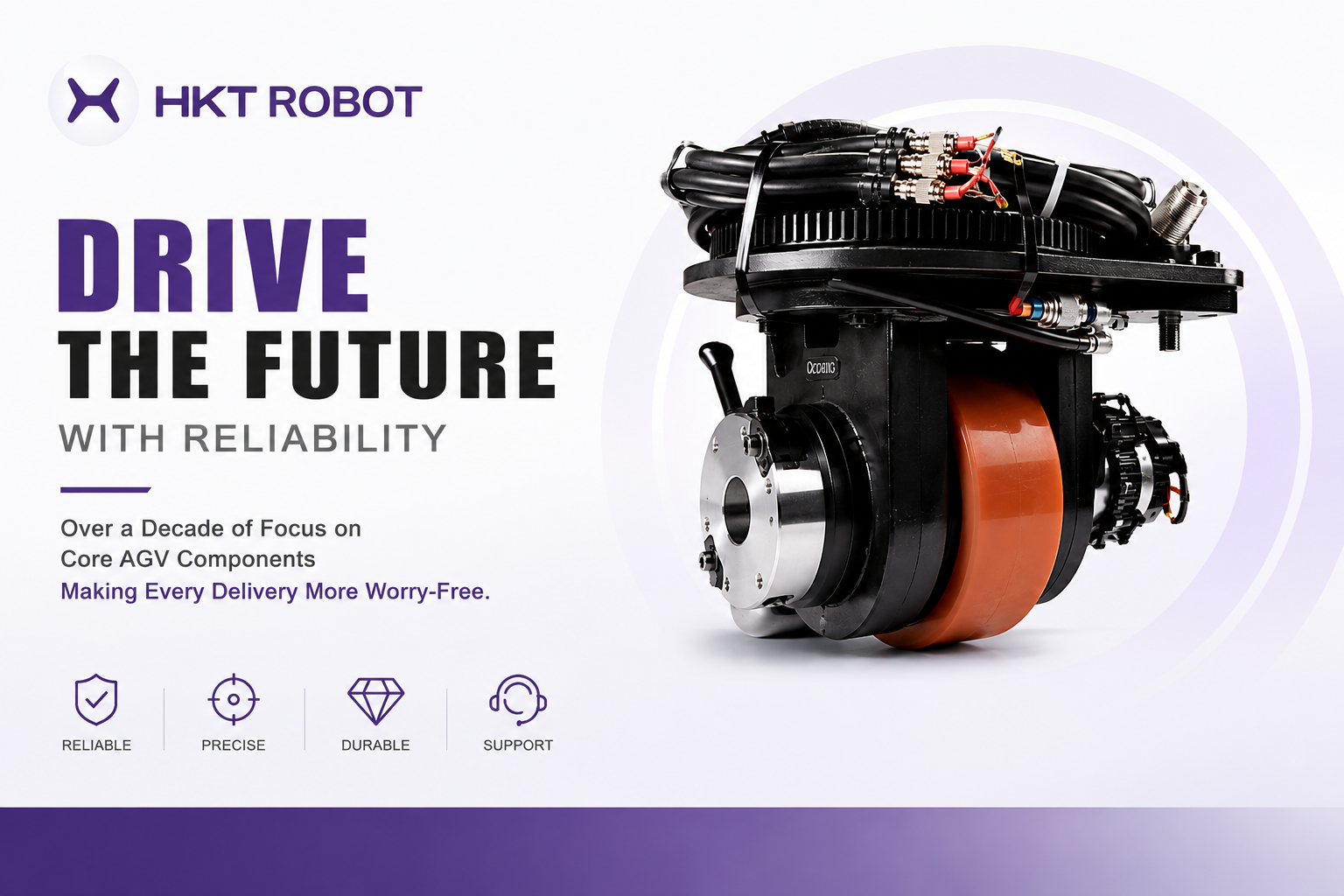
La configuración de la transmisión de un AGV o AMR afecta directamente a su flexibilidad de movimiento, capacidad de carga, precisión de la dirección, altura del chasis, complejidad del control y coste de fabricación. Cada tipo de transmisión tiene sus propias aplicaciones adecuadas, y ninguna solución única puede satisfacer todos los requisitos. La elección correcta debe basarse en la carga del vehículo, la velocidad de desplazamiento, las condiciones del suelo, el espacio de instalación y el movimiento requerido.
N.º 1 Rueda motriz direccional horizontal
Una rueda motriz direccional horizontal combina la conducción, la dirección, la retroalimentación de velocidad, la retroalimentación de ángulo y el frenado en un solo módulo. Al controlar el motor de accionamiento y el motor de dirección, el sistema puede ajustar con precisión la velocidad de desplazamiento y el ángulo de dirección.
El motor de accionamiento se instala generalmente en horizontal, lo que ayuda a reducir la altura total. Esto hace que el diseño sea adecuado para AGV de baja altura, AMR de perfil bajo y vehículos con espacio de instalación limitado. Una sola rueda motriz direccional puede soportar el desplazamiento hacia adelante y hacia atrás y los giros. Con dos o más ruedas de accionamiento y dirección independientes, junto con una disposición del chasis y un sistema de control adecuados, el vehículo también puede girar sobre sí mismo, moverse lateralmente y desplazarse en diagonal.
La dirección continua de 360 grados depende del tendido de los cables y del diseño estructural. Los cables estándar pueden retorcerse durante la rotación, por lo que algunos productos utilizan límites de dirección. Si se requiere una rotación continua, suele ser necesario un anillo deslizante u otro diseño antitorsión.

N.º 2 Rueda motriz direccional vertical
Una rueda motriz direccional vertical también combina las funciones de accionamiento, dirección, retroalimentación de velocidad, retroalimentación de ángulo y frenado. A diferencia de un diseño horizontal, su motor y transmisión suelen estar dispuestos verticalmente. Esto da como resultado una mayor altura total, pero requiere menos espacio horizontal.
Esta estructura es adecuada para AGV y AMR con ancho de chasis limitado pero suficiente espacio vertical. La disposición vertical también puede facilitar el diseño del motor y la transmisión como unidades modulares. Sin embargo, no proporciona automáticamente un mejor rendimiento en exteriores, impermeable, de superación de obstáculos o a prueba de explosiones.
El rendimiento ambiental depende principalmente del diseño de sellado, el grado de protección, la configuración de los rodamientos, los conectores, la protección contra la corrosión y las certificaciones. La capacidad de ascenso depende de la potencia del motor, la relación de transmisión, la tracción de las ruedas y el centro de gravedad del vehículo. La capacidad de superar obstáculos se ve afectada principalmente por el diámetro de las ruedas, la distancia al suelo, la suspensión y el diseño del chasis. La dirección continua de 360 grados también depende del anillo deslizante, el tendido de los cables o la estructura del límite de dirección.

N.º 3 Unidad de accionamiento diferencial
Un accionamiento diferencial de dos ruedas suele constar de dos ruedas impulsadas de forma independiente y varias ruedas de apoyo. Cuando ambas ruedas motrices giran a la misma velocidad en la misma dirección, el vehículo se mueve en línea recta. Cuando las velocidades de las ruedas son diferentes, el vehículo gira. Cuando las ruedas giran en direcciones opuestas, el vehículo puede rotar sobre sí mismo.
Este sistema de accionamiento tiene una estructura simple, un costo relativamente bajo y una tecnología de control madura. Se utiliza ampliamente en AMR de almacén, robots de reparto y AGV de servicio ligero a medio. No requiere un sistema de dirección mecánica adicional, por lo que la disposición del chasis es compacta y el mantenimiento es relativamente sencillo.
Sin embargo, una rueda motriz diferencial no puede moverse lateralmente directamente. Durante la rotación in situ, las ruedas pueden experimentar deslizamiento lateral, así como movimiento de rodadura. Esto puede aumentar el desgaste de los neumáticos y la resistencia a la dirección, especialmente bajo cargas pesadas, en suelos de alta fricción o con una vía de rueda ancha. Pequeñas diferencias en la velocidad de las ruedas, el diámetro de las ruedas o la fricción del suelo también pueden hacer que el vehículo se desvíe durante el desplazamiento en línea recta, por lo que se necesitan codificadores y algoritmos de control para una corrección continua.

N.º 4 Accionamiento de rueda Mecanum
Un accionamiento Mecanum suele utilizar cuatro ruedas. Al controlar la velocidad y la dirección de cada rueda, el vehículo puede moverse hacia adelante, hacia atrás, lateralmente, en diagonal y girar sobre sí mismo. No requiere un mecanismo de dirección independiente y es adecuado para aplicaciones interiores de servicio ligero a medio con espacio limitado y suelos planos.
Sin embargo, las ruedas Mecanum requieren una buena planitud del suelo y un control preciso. Su estructura de rodillos también es más propensa a producir vibraciones y desgaste. Para cargas pesadas, requisitos de alta tracción o suelos con muchas juntas, las ruedas motrices direccionales suelen ofrecer una mejor capacidad de carga, estabilidad y adaptabilidad al suelo.
N.º 5 Transmisión de orugas
Un AGV de orugas utiliza orugas izquierda y derecha para el movimiento y gira cambiando la velocidad de cada lado. Debido a que las orugas tienen una gran área de contacto con el suelo, proporcionan una fuerte tracción y una buena adaptabilidad al terreno. Esto las hace adecuadas para pendientes, suelos blandos, zonas exteriores y superficies irregulares.
Sin embargo, los sistemas de orugas son más complejos y suelen tener mayor resistencia a la rodadura, consumo de energía y costos de mantenimiento. Durante el giro, las orugas pueden deslizarse lateralmente, lo que puede aumentar el desgaste de las orugas y dañar los suelos interiores. Por esta razón, la transmisión de orugas es más adecuada para entornos especiales y no suele ser la primera opción para los AGV de almacén.
Conclusión: Cómo elegir la configuración de transmisión de AGV adecuada
La transmisión diferencial es adecuada para AGV y AMR de servicio ligero a medio que requieren un diseño simple y rentable. La rueda motriz direccional horizontal es una buena opción para vehículos de perfil bajo, de baja altura y muy flexibles. La transmisión direccional vertical es más adecuada para diseños de chasis con espacio horizontal limitado pero suficiente espacio vertical. Las ruedas Mecanum son adecuadas para el movimiento omnidireccional en suelos interiores lisos, mientras que la transmisión de orugas es mejor para terrenos difíciles.
En la selección real, el tipo de transmisión no debe considerarse solo. También deben evaluarse el peso del vehículo, la carga útil máxima, la velocidad de desplazamiento, el tamaño del chasis, el estado del suelo, la pendiente, el ciclo de trabajo, la precisión de posicionamiento y el presupuesto. En HKT ROBOT, nuestro equipo de ingeniería revisa estos requisitos y recomienda una rueda motriz direccional o una solución de transmisión diferencial adecuadas. Envíenos su diseño de chasis y parámetros de funcionamiento, y le ayudaremos a seleccionar o personalizar la configuración adecuada.
Compartir:
Ruedas motrices de dirección horizontal para un funcionamiento eficiente y estable de AGV/AMR
Ruedas de tracción diferencial: Rendimiento mejorado para la movilidad de AGV y AMR