

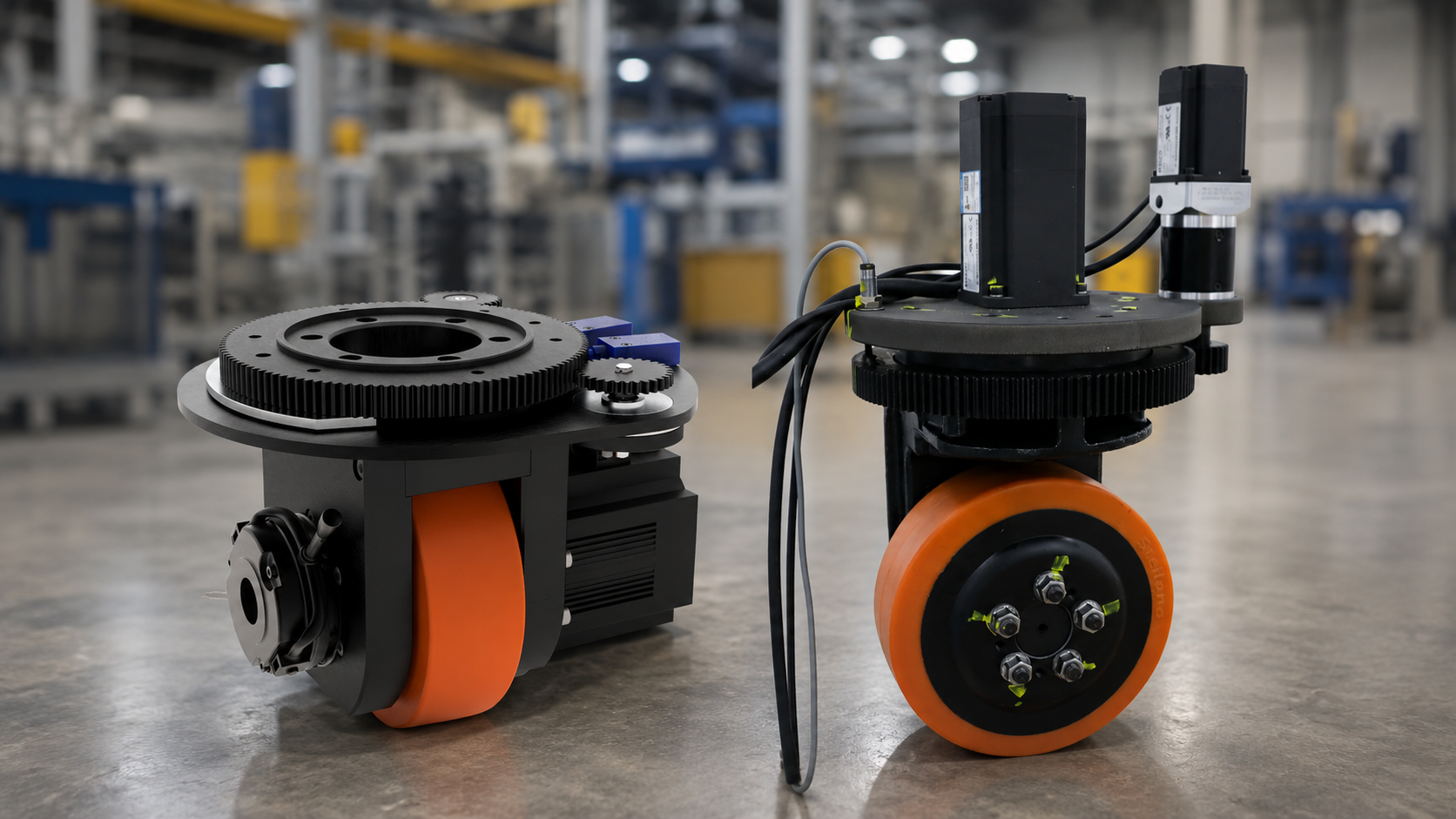
Un AGV omnidireccional de cuatro ruedas direccionales es una estructura común de chasis de robot móvil con alta flexibilidad. Por lo general, tiene cuatro módulos de dirección y tracción independientes instalados en las cuatro esquinas de la carrocería del vehículo. Cada módulo de rueda puede impulsar el vehículo y controlar su ángulo de dirección de forma independiente. Al coordinar la velocidad y el ángulo de las cuatro ruedas, el AGV puede avanzar, moverse lateralmente, moverse en diagonal, girar en su lugar y realizar giros de radio pequeño.
Para talleres de fábrica, logística de almacén, manejo de materiales pesados, acoplamiento de líneas de producción y operación en espacios estrechos, un AGV omnidireccional de cuatro ruedas direccionales puede proporcionar alta movilidad y gran capacidad de carga. Al mismo tiempo, también requiere estándares más altos para el diseño de la estructura mecánica, la distribución de la carga, la sincronización de las ruedas y el control de movimiento.
HKT-ROBOT proporciona módulos de dirección y tracción para AGV/AMR, ruedas motrices, sistemas de servoaccionamiento, controladores AGV y soluciones de accionamiento para robots móviles. Además de las soluciones de AGV omnidireccionales de cuatro ruedas direccionales, también podemos ayudar a los clientes a evaluar una estructura de accionamiento de chasis de AGV más adecuada en función de la capacidad de carga, el tamaño del vehículo, las condiciones del suelo, la velocidad de funcionamiento y los requisitos de control.

¿Qué es un AGV omnidireccional de cuatro ruedas direccionales?
Un AGV omnidireccional de cuatro ruedas direccionales es un vehículo guiado automáticamente que utiliza cuatro módulos de dirección y tracción como sus principales unidades de propulsión y dirección. Cada módulo de dirección y tracción suele incluir un motor de propulsión, un motor de dirección, un reductor, una rueda, un codificador y una estructura de montaje.
A diferencia de un AGV de tracción diferencial estándar, un AGV de dirección de cuatro ruedas no depende de la diferencia de velocidad entre las ruedas izquierda y derecha para girar. En su lugar, utiliza la dirección y propulsión independientes de cada módulo de rueda para lograr un control de movimiento más flexible. El vehículo puede moverse lateralmente sin realizar un gran cambio en la dirección de la carrocería, y también puede girar en su lugar para ajustar rápidamente su rumbo.
Esta estructura le da al AGV más libertad de movimiento en condiciones de trabajo complejas. Es especialmente adecuado para aplicaciones que requieren movimiento multidireccional, posicionamiento preciso y transporte de cargas pesadas.

Estructura del chasis de un AGV de cuatro ruedas direccionales
El chasis de un AGV de cuatro ruedas direccionales suele colocar cuatro módulos de dirección y tracción en las cuatro esquinas de la carrocería del vehículo. Cada módulo funciona como rueda motriz y rueda direccional. En la mayoría de los casos, un módulo de dirección y tracción está equipado con dos motores: un motor impulsa la rotación de la rueda y el otro motor controla el ángulo de dirección.
Para la navegación, un AGV omnidireccional de cuatro ruedas puede utilizar navegación magnética, navegación por código QR, SLAM láser o un método de navegación combinado, según el entorno del sitio y los requisitos del proyecto.
Esta estructura le da al vehículo una mayor tracción y un movimiento más flexible. Dado que los cuatro módulos de rueda proporcionan fuerza motriz juntos, el AGV puede lograr una mejor capacidad de carga y estabilidad de funcionamiento. Para plataformas de servicio pesado, vehículos de transferencia de herramientas, sistemas de transporte de líneas de producción automatizadas y AGV de transferencia de almacenes, la estructura de cuatro ruedas direccionales ofrece claras ventajas.
Sin embargo, el diseño de un chasis de cuatro ruedas direccionales también es más complejo que un chasis de AGV estándar. Durante la etapa de diseño, se deben considerar cuidadosamente los siguientes factores:
-
Carga del vehículo y centro de gravedad
-
Posición de montaje de los cuatro módulos de dirección y tracción
-
Diámetro de la rueda, ancho de la rueda y material de la banda de rodadura de la rueda
-
Capacidad de carga de cada módulo de dirección y tracción
-
Planitud del suelo y capacidad de paso
-
Estructura de suspensión y distribución de carga
-
Potencia del motor y relación de transmisión
-
Coincidencia entre el controlador y el sistema de accionamiento
Si la estructura del chasis no está diseñada correctamente, el AGV puede enfrentar problemas al pasar sobre suelos irregulares. Por ejemplo, algunas ruedas pueden no soportar suficiente carga, las ruedas motrices pueden patinar, la carga del motor puede ser demasiado alta o el vehículo puede funcionar de forma inestable.
Por lo tanto, el diseño de un AGV omnidireccional de dirección de cuatro ruedas no solo debe centrarse en los parámetros de un solo módulo de rueda. También debe evaluarse junto con la estructura completa del vehículo y el entorno de trabajo real.
Modos de movimiento de un AGV omnidireccional de cuatro ruedas direccionales
La ventaja clave de un AGV omnidireccional de cuatro ruedas direccionales es su flexibilidad en los modos de movimiento. Al controlar el ángulo de dirección y la velocidad de los cuatro módulos de rueda, el vehículo puede lograr diferentes patrones de movimiento.
Los modos de movimiento comunes incluyen:
-
Movimiento hacia adelante y hacia atrás: Adecuado para el movimiento normal en pasillos estándar.
-
Movimiento lateral: Adecuado para espacios estrechos, acoplamiento de estaciones de trabajo y carga o descarga lateral.
-
Movimiento diagonal: Adecuado para rutas complejas y movimiento multiángulo.
-
Rotación en el sitio: Adecuado para ajustar rápidamente la dirección del vehículo en espacios pequeños.
-
Giro de radio pequeño: Adecuado para talleres o almacenes con espacio de giro limitado.
-
Cambio multimodo: El vehículo puede cambiar entre diferentes modos de movimiento según la trayectoria y las condiciones de trabajo.
En comparación con un AGV de tracción diferencial estándar, un AGV omnidireccional con cuatro ruedas direccionales independientes puede ajustar su posición y completar un acoplamiento preciso más fácilmente en áreas estrechas. Para aplicaciones que requieren movimiento lateral, movimiento diagonal, rotación y parada de alta precisión, esta estructura puede mejorar la movilidad del vehículo y la eficiencia de trabajo.

Ventajas de un AGV de cuatro ruedas direccionales
Un AGV omnidireccional de cuatro ruedas direccionales es adecuado para proyectos que requieren alta flexibilidad, gran capacidad de carga y posicionamiento preciso. Sus principales ventajas incluyen:
1. Alta flexibilidad de movimiento
Los cuatro módulos de dirección y tracción pueden girar de forma independiente. El vehículo puede moverse hacia adelante, hacia atrás, lateralmente, en diagonal y girar en el sitio. Para talleres o almacenes con espacio limitado, esta flexibilidad puede reducir el área de giro requerida y mejorar la libertad de planificación de rutas.
2. Adecuado para transporte de cargas pesadas
Los cuatro módulos de rueda proporcionan tracción y soporte juntos, lo que ayuda a mejorar la capacidad de carga general del vehículo. Para herramientas grandes, moldes, paletas, piezas de equipos y materiales pesados, la estructura de cuatro ruedas direccionales ofrece una buena adaptabilidad.
3. Mejor para el acoplamiento preciso
En el acoplamiento de líneas de producción, acoplamiento de equipos, acoplamiento de estanterías o aplicaciones de carga y descarga automática, el AGV necesita ajustar su posición y ángulo con precisión. Un AGV omnidireccional de cuatro ruedas direccionales puede realizar ajustes de posición más finos mediante el movimiento multidireccional.
4. Adecuado para rutas complejas
Un AGV de cuatro ruedas direccionales puede cambiar los modos de movimiento según la ruta del sitio. Es adecuado para entornos de trabajo con pasillos complejos, espacio de giro limitado y diseños densos de estaciones de trabajo.
Desafíos de diseño de un AGV de cuatro ruedas direccionales
Aunque un AGV omnidireccional de cuatro ruedas direccionales tiene una gran capacidad de movimiento, no es la solución de chasis más simple. En comparación con las estructuras de tracción diferencial, tracción de dirección única o tracción de dirección doble, su diseño mecánico y sistema de control son más complejos.
1. Algoritmo de control más complejo
Los cuatro módulos de rueda necesitan coordinar el ángulo de dirección y la velocidad de la rueda al mismo tiempo. Si el control no es consistente, puede causar mayor desgaste de los neumáticos, vibración de la carrocería, desviación de la trayectoria o movimiento inestable. El controlador necesita calcular el ángulo y la velocidad de cada rueda en tiempo real para mantener el vehículo en movimiento suave.
2. Requisitos de diseño mecánico más altos
La precisión de montaje de los módulos de dirección y tracción, la rigidez del chasis, la distribución de la carga y la estructura de soporte pueden afectar el rendimiento del vehículo. Si la carga no se distribuye de manera uniforme, algunos módulos de rueda pueden soportar demasiada carga, mientras que otros pueden no proporcionar suficiente fuerza de propulsión.
3. Más sensible a las condiciones del suelo
Un AGV de cuatro ruedas direccionales suele ser más adecuado para suelos industriales planos. Si el suelo tiene pendientes claras, huecos, protuberancias o depresiones, la estructura de la rueda, el método de absorción de impactos y la capacidad de conducción deben evaluarse con anticipación.
4. Mayor costo y requisitos de mantenimiento
Una estructura de cuatro ruedas direccionales necesita más motores, accionamientos, codificadores y unidades de control. Su costo de sistema suele ser más alto que una estructura de tracción diferencial simple. Durante el mantenimiento posterior, el usuario también debe prestar atención al desgaste de las ruedas, el estado de la banda de rodadura, la holgura del mecanismo de dirección y la estabilidad del control eléctrico.
Escenarios de aplicación de un AGV omnidireccional de cuatro ruedas direccionales
Un AGV omnidireccional de cuatro ruedas direccionales es adecuado para las siguientes aplicaciones:
-
Transferencia de materiales en talleres de fábrica
-
Manipulación logística de almacén
-
Transporte de plataformas de servicio pesado
-
Transferencia de herramientas y accesorios grandes
-
Acoplamiento de líneas de producción automatizadas
-
Movimiento lateral en pasillos estrechos
-
Transporte de moldes, paletas y piezas de equipos
-
Plataformas móviles que necesitan rotación en el sitio
-
Sistemas de manipulación automática que requieren alta precisión de posicionamiento
Si un proyecto requiere alta flexibilidad, movimiento multidireccional, gran capacidad de carga y acoplamiento preciso, un AGV omnidireccional de cuatro ruedas direccionales es una solución que vale la pena considerar.
Sin embargo, si el proyecto solo requiere un movimiento simple hacia adelante, hacia atrás y un giro normal, la solución de cuatro ruedas direccionales puede no ser la opción más rentable. En aplicaciones reales, la solución de accionamiento debe seleccionarse en función de la capacidad de carga, la velocidad, las condiciones del suelo, el costo, las necesidades de mantenimiento y la complejidad del control.
Cómo HKT-ROBOT apoya la selección de soluciones de accionamiento para AGV/AMR
HKT-ROBOT puede proporcionar productos de sistemas de accionamiento AGV/AMR y soporte de selección según las necesidades de aplicación de cada cliente. Nuestros productos incluyen módulos de dirección y tracción, ruedas motrices, reductores de buje de rueda, servomotores de 48 V, servovariadores, controladores AGV y otros componentes de accionamiento de robots móviles.
Además de las soluciones de AGV omnidireccionales de cuatro ruedas direccionales, HKT-ROBOT también puede ayudar a evaluar otros métodos de accionamiento en función de los requisitos del proyecto. Estos pueden incluir accionamiento de dirección única, accionamiento de dirección doble, accionamiento diferencial, accionamiento de rueda Mecanum, accionamiento de dirección de servicio pesado y módulos de dirección y tracción combinados con ruedas de soporte.
Para diferentes proyectos de AGV/AMR, la solución adecuada a menudo depende de la capacidad de carga, el tamaño del vehículo, las condiciones del suelo, los requisitos de movimiento, la complejidad del control y el presupuesto. HKT-ROBOT puede ayudar a combinar módulos de dirección y tracción, ruedas motrices, motores, accionamientos y sistemas de control adecuados según los parámetros del vehículo y el escenario de aplicación del cliente.
Si está desarrollando un AGV, AMR, robot de almacén, plataforma móvil de servicio pesado o equipo de manipulación automatizado, puede proporcionar a HKT-ROBOT la siguiente información:
-
Peso total del vehículo y carga máxima
-
Tamaño del chasis y espacio de montaje
-
Velocidad de funcionamiento y aceleración requeridas
-
Si se necesita movimiento lateral, movimiento diagonal o rotación in situ
-
Entorno del suelo y condiciones de la pendiente
-
Método de navegación
-
Requisitos del protocolo de control, como CANopen o EtherCAT
-
Tensión de la batería y requisitos del sistema eléctrico
-
Aplicación objetivo y frecuencia de trabajo
En base a esta información, podemos ayudarle a evaluar una solución de accionamiento AGV adecuada, reducir los riesgos de selección y mejorar la estabilidad de funcionamiento de todo el vehículo.
Compartir:
Controlador AGV para Robots Móviles: Tipos, Especificaciones y Cómo Elegir el Correcto
Servoaccionamiento Integrado para AGV: Ventajas, Especificaciones y Cuándo Elegirlo